Tuesday, October 6, 2026 · Trucking & Freight
Logistics Firms Bridge Legacy Systems With E-Invoicing and EDI
Noted by Martijn Graat · 887 reads
Legacy systems and manual workflows slow supply chain digitisation. Anna Fuller says process mapping and structured e-invoicing can help teams automate work.
Home » Logistics Firms Bridge Legacy Systems With E-Invoicing and EDI
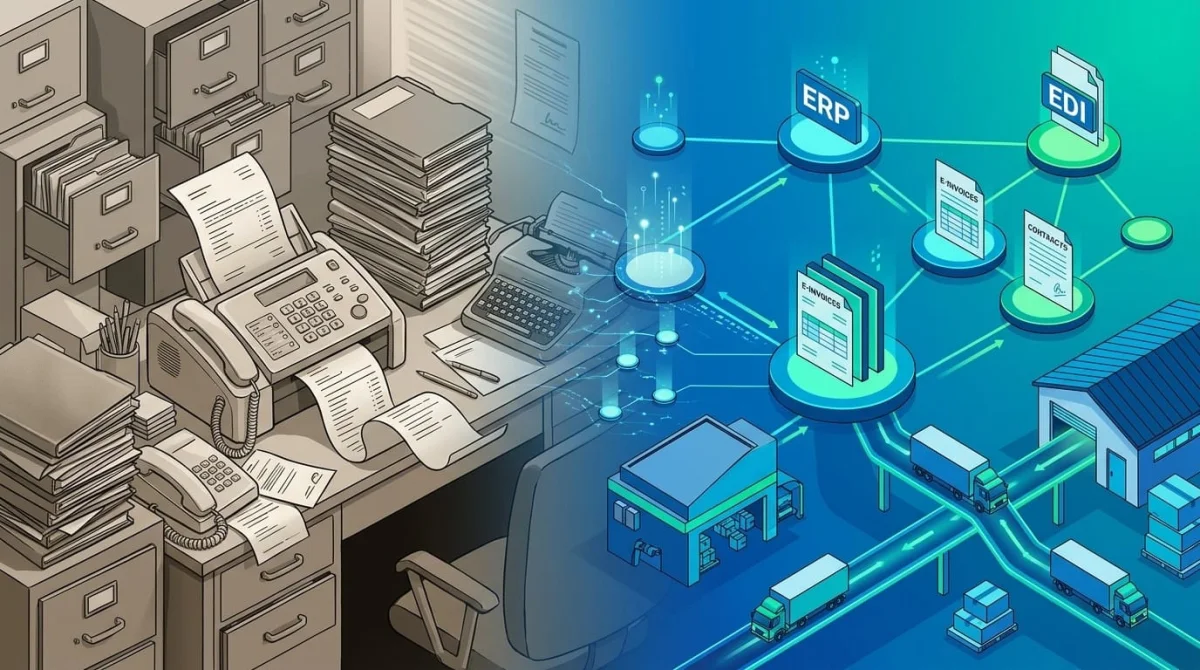
For logistics teams, digital transformation is less about installing the newest software than making information move reliably between old systems, newer tools and the people who use them. Anna Fuller, Senior Sales Executive at Descartes, says that challenge has shaped the industry from her early experience waiting for customer orders to print on a fax machine to today’s connected supply chains.
Fuller discussed the issue on the Does Logistics Matter? podcast. Her starting point is that logistics affects people every day. For businesses, the practical consequence is clear: when information stalls between a shipper, supplier, carrier or customer, routine work can become slower and harder to manage.
Why older systems stay in place
Many companies still depend on enterprise resource planning systems and other technology installed years ago. Replacing a core platform can be expensive and risky, and a business can’t treat its operational backbone like a phone that gets upgraded every few years. If a system change interrupts logistics processes, orders and goods may stop moving, with revenue at stake.
That exposure helps explain why newer software often has to connect with established infrastructure instead of replacing it. A company may want modern tools and faster data exchange while continuing to rely on an ERP that supports everyday operations. The work is therefore partly technical: systems with different designs and capabilities need a reliable way to exchange information.
It’s also a people and process challenge. Fuller identifies human resistance to change as a major obstacle to digital transformation. A tool that looks straightforward to its designers may add steps or confusion for staff if it doesn’t match the way work actually gets done. Starting with the technology alone can leave teams with new software but little reason to use it consistently.
Her advice is to involve operational staff early, map current workflows and set clear business goals before selecting or implementing systems. That sequence gives teams a chance to identify where work gets stuck and what a change should improve. It can also help keep a technology project focused on a real operational need instead of adding complexity for its own sake.
Connections across the supply chain
A business’s systems don’t operate in isolation. Suppliers, logistics providers and customers may each have different priorities, processes and software. A company may need to connect modern, API-first applications with older ERP platforms and established Electronic Data Interchange (EDI) standards.
For most firms, building and maintaining those connections isn’t a core business activity. They need orders and other operational data to reach the right parties without requiring staff to move information manually between systems. Fuller compares the desired experience to turning on a tap: the user expects the flow to work without needing to manage the infrastructure behind it.
That expectation puts the focus on integration that fits the company’s existing environment. The aim is not simply to add a connection; it’s to make information exchange useful to the teams handling orders and invoices. When the systems and processes are well matched, automation can reduce repetitive handling and make routine information easier to process.
EDI connections have often been adopted because customers require them. Fuller says a newer driver is the spread of mandatory e-invoicing and e-reporting requirements across Europe and elsewhere. Those requirements are prompting companies to review how they exchange invoice data, bringing finance workflows into the wider digitisation effort.
Structured invoices change finance workflows
For finance departments accustomed to paper documents or PDF invoices, structured digital formats such as machine-readable XML can feel like a significant shift. A document that a person can read is not necessarily formatted for software to process directly. Structured data can allow systems to handle invoice information with less manual entry, once the transition is in place.
Fuller says companies can see the benefits after they make that change: “They can see that it does have advantages and that they are actually able to process a lot of invoices much faster. As a result, resources can be allocated to more value-added tasks.” The operational case rests on processing speed and on freeing staff from repetitive invoice work.
The same principle applies to order processing and other EDI exchanges. Automation is most useful when it targets a task that happens often and currently depends on manual effort. Simply digitising a document or adding software won’t guarantee a better process if the underlying workflow remains unclear.
Start with the work
Fuller’s practical recommendation is to examine existing workflows closely and identify high-volume, repetitive tasks. Companies can then assess where automated EDI or e-invoicing could save time, reduce operational risk and create business value. Mapping those tasks also gives teams a clearer basis for deciding which connections and processes to address first.
For logistics and finance managers, that makes staff involvement and process mapping part of the technology work itself. The goal is information that moves between systems with less manual handling while supporting the operation people already need to run. As e-invoicing requirements prompt more businesses to review their workflows, the ability to connect new tools with established systems will remain central to getting goods and transactions through the supply chain.
Fuller joined the podcast as a Senior Sales Executive at Descartes. The full conversation is available on Does Logistics Matter?, Spotify, Apple Podcasts and other podcast platforms.
Marie Baronstraat 11, 3056AA Rotterdam, The Netherlands • CoC: 55851991 • VAT: NL001643631B88 • Website design: Commpany


