Sunday, October 25, 2026 · Ocean Shipping & Ports
Suez Canal Container Capacity Tops Half of Pre-Disruption Levels
Noted by Joseph Smith · 343 reads
Weekly Suez transits reached 753,000 TEU in early October as carriers restore Asia-Europe services, while Asian port congestion clouds the capacity outlook.
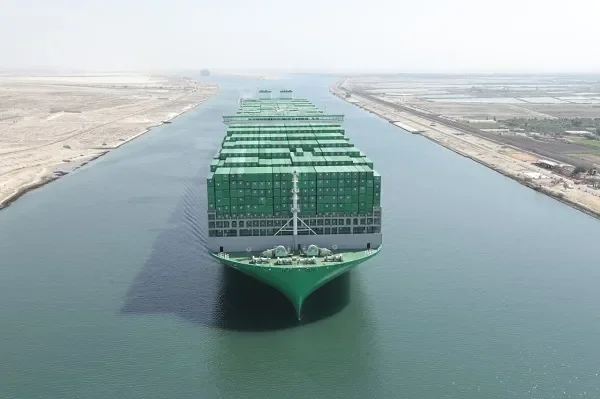
Container capacity moving through the Suez Canal has climbed above half its pre-disruption level for the first time since the Red Sea crisis began. The recovery is changing the balance between the canal and the longer route around the Cape of Good Hope, with practical consequences for vessel availability and Asia-Europe schedules. But rising congestion at Asian ports could complicate the expected release of capacity.
In the first two weeks of October, weekly container ship capacity transiting the canal averaged 753,000 TEU, Clarksons Research data show. The comparable figure for the same period in 2023 was 1.457 million TEU. Niels Rasmussen, chief shipping analyst at BIMCO, said this was the first time since the crisis began that weekly transits had exceeded 50% of pre-disruption levels. TEU, or twenty-foot equivalent unit, is the standard measure of container capacity.
Carrier services are returning to the canal
The shift reflects a series of service changes announced since early July. On 6 July 2026, the Gemini Alliance, formed by Maersk and Hapag-Lloyd, said its AE15/SE3 Asia-Mediterranean service would return to the Suez Canal. The alliance later announced that five additional services would resume their normal routings, including its remaining three Asia-Mediterranean services.
Other major operators have also announced routing changes. Members of the Ocean Alliance and the Premier Alliance, along with MSC, have made announcements affecting their services. Carriers have announced changes to 16 services since early July. For freight forwarders and shippers, that means checking service-level plans and vessel schedules as carriers adjust routings. An announcement about a return to a usual route does not, by itself, establish when every sailing will follow it.
The changing service mix is visible in the overall routing share. In the first two weeks of October, 36% of container ship capacity routed through either the canal or the Cape transited Suez. That is a substantial rise from the 8% average recorded between 2024 and mid-2026. Before the attacks began, the canal carried 80% of capacity on those routes, so the current share still leaves a considerable gap.
The detour reshaped fleet demand
Container lines began avoiding the Suez Canal and Red Sea in December 2023, choosing instead to sail around the Cape of Good Hope. That longer passage tied up ships for more time on each round trip, increasing the fleet capacity needed to maintain services. By the final week of 2023, weekly container capacity through Suez had dropped to 330,000 TEU, compared with a year-to-date average of 1.29 million TEU.
Low transit levels persisted. From early February 2024 to mid-2026, weekly capacity through the canal averaged 141,000 TEU, according to Rasmussen. He put that at an average of 11% of the capacity recorded during the same weeks of 2023. Against that extended period of diversions, the October figure marks a sharp change in how carriers are routing container ships.
Direction of travel shows that the recovery remains uneven. Southbound sailings led the initial increase in canal traffic. In the third quarter, northbound capacity reached 75% of southbound capacity; during the first weeks of October, the ratio rose to 81%. The move toward a more balanced flow is another sign of recovery, though the figures still show more capacity moving south than north.
Capacity is returning, but congestion matters
Rasmussen estimates that diversions around the Cape increased global container ship demand by about 10%. As ships spend less time on the longer route, that extra demand is now falling quickly. The implication is that more vessel capacity could become available to the market as services return to Suez.
That capacity effect may not show up cleanly in schedules or freight market conditions yet. Rasmussen said the return to the canal has coincided with increased port congestion in Asia, and that the full effect on supply and demand has yet to be seen. Port delays can absorb time that carriers might otherwise gain from shorter voyages, making the route change only one part of the schedule picture.
For cargo owners and forwarders, the near-term task is to track which services are changing, when those changes take effect, and how actual vessel schedules perform. A shorter route can improve transit efficiency and make Asia-Europe and Asia-Mediterranean planning more predictable, but congestion remains a source of disruption. Buyers and importers will need to watch how the added vessel capacity affects freight costs, lead times and inventory plans. The 50% threshold is a meaningful marker; the pace and operational effect of further returns will depend on carrier schedules and port conditions.