Tuesday, October 20, 2026 · Trucking & Freight
Ho Chi Minh City Port Expansion Targets 33.16 Million TEUs by 2030
Noted by John Williams · 633 reads
Deep-water terminals, a planned transshipment port and better inland links could reshape cargo flows through southern Vietnam.
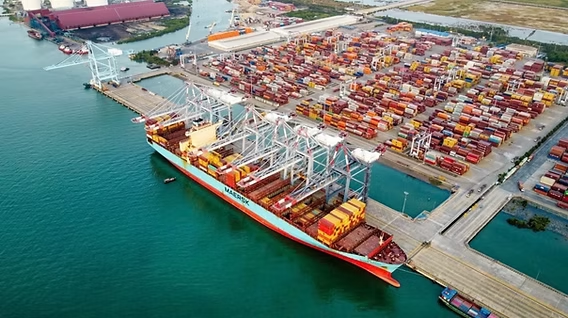
Ho Chi Minh City’s port expansion is taking shape as a connected freight corridor, with deep-water terminals on the coast, inland links and a planned international transshipment port. For shippers, the test will be whether those pieces work together well enough to improve routing, schedules and cargo handoffs as volumes grow.
The city’s maritime footprint expanded on July 1, 2025, when Ho Chi Minh City merged with Binh Duong and Ba Ria-Vung Tau provinces. That change brought the Cai Mep-Thi Vai port cluster into the enlarged city. Cai Mep-Thi Vai is Vietnam’s main deep-water container gateway in the south and can berth vessels of around 214,000 deadweight tonnes. Its ability to receive mainline ships on intercontinental routes gives cargo owners a direct ocean connection from the region.
Coastal capacity and investment
Several large projects are adding to that foundation. The approved Cai Mep Ha port project carries a planned investment of about $1.95 billion across roughly 351 hectares, including nearly 230 hectares for container operations. Thi Vai International Port has committed more than VND 2.7 trillion, or about $115.7 million, to facility upgrades.
The city’s approved port master plan targets around $3 billion in investment. Its direction is a move away from relying on a crowded river gateway toward a corridor that connects the urban core with coastal terminals. That shift matters operationally: more berth capacity can create options for ocean services, while the value of those options depends on how efficiently cargo moves between ports, factories, warehouses and inland distribution points.
By 2030, the plan sets a target of 463.4 million to 512.5 million tonnes of total cargo and 3 million to 3.3 million passenger journeys. It projects container volumes of 29.63 million to 33.16 million TEUs, excluding international transshipment cargo. For comparison, Vietnam’s national seaport plan sets a 2030 range of 500 million to 564 million tonnes and 29 million to 33 million TEUs for the wider southeastern seaport group, which also includes Dong Nai and Long An.
These are planning targets, rather than a report of current throughput. They reflect expectations of continued manufacturing investment across southern Vietnam as companies distribute production around the region. For forwarders and carriers, that outlook points to more demand for service contracts and makes capacity planning, carrier allocation and dependable peak-season routing more consequential.
Can Gio’s transshipment ambition
The proposed Can Gio International Transshipment Port is the clearest step toward competing for cargo that currently passes through established regional hubs. Its investment policy was approved in January 2025. Mediterranean Shipping Company (MSC) and Vietnam Maritime Corporation (VIMC) proposed the project, planned for about 571 hectares on Go Con Cho islet in Can Gio. Initial investment is estimated at about VND 50 trillion, close to $2 billion.
MSC’s participation signals interest from a major global carrier in the area’s potential beyond handling Vietnamese imports and exports. If the project proceeds as planned, it could attract transshipment cargo and give southern Vietnam more direct connections, reducing reliance on feeder links. That could shorten transit times for some shipments to and from the region, though the source provides no operating schedule or projected throughput for the proposed port.
For cargo owners, a new transshipment option would matter through its service pattern: which routes call, how often connections are available and how reliably cargo can transfer onward. New terminal capacity alone doesn’t settle those questions. The land side of the network will determine whether larger volumes can move without adding delays between vessel arrival and final delivery.
Coordination is the operating test
More cargo can also intensify truck queues, tighten warehouse space and add pressure around port communities. Sharing freight across roads, rail, barges and coastal shipping can ease the burden on any one mode, but it requires workable connections and coordinated processes. Shippers will judge progress in concrete terms: dwell times, schedule reliability and total landed costs.
That coordination problem was raised at a May 2026 customer conference, where Saigon Newport Corporation (SNP) and Phuoc An Port described bottlenecks linking seaports, industrial parks and supply chains in neighboring Dong Nai. They pointed to infrastructure, logistics procedures and gaps in supply-chain coordination. Suggested responses included administrative changes, improved operating mechanisms and broader use of inland waterway transport. Customs authorities also committed to resolving business difficulties more quickly.
The SNP-Phuoc An partnership offers a measure of activity already achieved through collaboration. In just over a year, it brought in eight shipping lines, launched seven service routes, handled 197 vessel calls and moved 190,642 TEUs. Those figures show the service network and cargo flows the partnership has handled; they don’t, on their own, establish how much time or cost it saved shippers.
The practical takeaway is that Ho Chi Minh City is building capacity across multiple parts of its port system, while the connection between those parts remains central to performance. For logistics teams, the indicators to track are whether inland waterway use widens, port-to-industrial-zone handoffs improve and the planned Can Gio project advances toward service. Those details will show whether the corridor can translate investment and ambitious volume targets into more predictable cargo movement.


