Thursday, November 12, 2026 · Trucking & Freight
Diesel Holds at $6.23 as Refining Margins Outpace Falling Crude
Noted by Julie Van de Kamp · 586 reads
SONAR’s Nov. 9 index put diesel at $6.23 per gallon, with refining margins and thin inventories limiting relief from falling Brent.
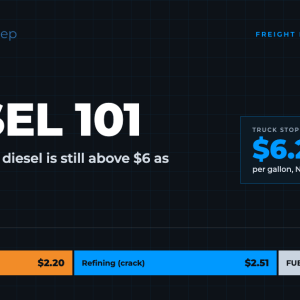
Diesel’s price at the truck stop is being driven more by tight refined-fuel supply than by crude oil. SONAR’s truck stop diesel index, DTS.USA, stood at $6.23 per gallon on Nov. 9, 2026, even though Brent crude had fallen sharply from its late-October high. For carriers and shippers, the gap between crude and diesel costs makes the fuel index and reset schedule in a surcharge agreement especially consequential.
At 7 miles per gallon, diesel at $6.23 works out to about $0.89 per mile. That is up from roughly $0.54 per mile at the year-earlier price of $3.78 per gallon. The increase leaves carriers with a much higher fuel bill per mile, while weekly surcharge measures may take longer to reflect daily price changes.
Refining accounts for the largest share
SONAR’s breakdown of the Nov. 9 truck stop price assigns $2.20 per gallon to crude, $2.51 to the refining margin and $1.52 to delivery, taxes and retail margin. Crude represents about 35% of the final price; refining is now the largest component.
The refining margin, commonly measured as the diesel crack spread, is the difference between wholesale ultra-low-sulfur diesel (ULSD) and crude on a comparable per-gallon basis. SONAR calculates it using ULSDR.USA minus Brent. The spread reached $2.51 per gallon on Nov. 9, compared with an average of $0.87 in January and February 2026—about three times as high.
That split helps explain why the pump price has responded slowly to cheaper crude. Brent was down 21% from its Oct. 30 peak by Nov. 9, while truck stop diesel had fallen just 2.5%. A $25-per-barrel Brent decline over that period did little to offset the elevated refining margin and the costs between the wholesale rack and retail pump.
Supply and transport constraints tighten the market
Several pressures are limiting the amount of diesel available to buyers. The International Energy Agency puts refined-product exports from the Middle East at 1.9 million barrels per day, compared with 4.7 million before the disruption described in the market outlook. Refinery damage in the Middle East and Russia has added to the squeeze.
Shipping has also become slower. Restrictions affecting the Strait of Hormuz and Red Sea have lengthened some tanker voyages from about 24 days to 54 days. Longer transit times can keep cargoes in motion for more time before they reach buyers, adding strain when inventories are already low.
U.S. refiners have limited room to raise output quickly. Refineries operated at 96% of capacity in the third quarter, and the country has less refining capacity than it did in 2019. Meanwhile, overseas demand continues to compete for U.S. fuel: distillate exports exceeded their 2021–2025 highs in six of the seven months through July.
Inventory levels leave little cushion. In late September, U.S. distillate stocks were 13% below the five-year average. East Coast stocks were 32% below that benchmark. With less stored product available to absorb supply delays or demand shifts, wholesale prices can remain firm even when crude declines.
Retail and wholesale prices move on different schedules
The gap between the truck stop price and the wholesale rack price is tracked by SONAR’s FUELS spread. It widened to $1.52 per gallon on Nov. 9, up from $1.23 on Oct. 30, as rack prices fell faster than pump prices. The rack price reflects wholesale ULSD at fuel terminals; the truck stop price also includes delivery, taxes and retail margin.
Index choice matters when that movement feeds into freight payments. On Nov. 9, SONAR’s daily truck stop index was about 10.5 cents per gallon above the Energy Information Administration’s weekly national average. A contract tied to a weekly measure may therefore reflect a different price—and a later one—than a daily index during a fast-moving market.
Carriers should compare the price measure used for their operating costs with the index and reset date in their fuel surcharge terms. Shippers need to understand how those same timing rules affect billed fuel adjustments. Brokers setting spot quotes also face a risk that a fuel assumption will be stale within a week while wholesale and retail prices move at different speeds.
EIA projects easing prices, with near-term uncertainty
The EIA’s November Short-Term Energy Outlook forecasts retail diesel at $6.05 per gallon in the fourth quarter of 2026, declining to $4.80 in the fourth quarter of 2027. At 7 miles per gallon, those prices equate to approximately $0.86 and $0.69 per mile, respectively.
The outlook also raised its forecast for the 2027 annual retail average by 12%, to $5.03 per gallon from $4.49 in October. The EIA cautions that Middle East flows remain fragile, leaving room for short-term price swings beyond the forecast’s monthly path.
For freight teams, the useful signal is the relationship between crude, the diesel crack, inventories and the rack-to-retail spread—not Brent alone. Until refined-product supply and delivery pressures ease, a fall in crude may offer only limited or delayed relief at the truck stop.