Tuesday, November 10, 2026 · Trucking & Freight
SONAR's MCP Connector Puts Freight Rate and Capacity Data Inside AI Assistants
Noted by Julie Van de Kamp · 535 reads
SONAR MCP lets Claude and Copilot answer freight rate, capacity and carrier safety questions in plain language, grounded in SONAR data.
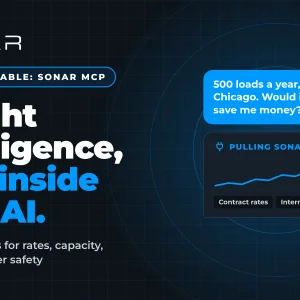
Freight teams have spent years flipping between rate dashboards and memorizing index tickers. SONAR's new MCP connector is aimed at ending that routine. Ask a compatible AI assistant a question about lane costs or capacity in plain English, and the answer comes back built on SONAR data.
What the connector does
SONAR MCP is built on the Model Context Protocol, the open standard Anthropic introduced in November 2024 that lets AI models and agents connect to outside tools and data. Think of it as an API designed for AI assistants rather than for human-built software.
Once the connector is switched on, the assistant decides which SONAR tools to call based on the question and on the user's SONAR permissions. It then merges those results into a single plain-language answer. Here's the thing: the permission layer matters. Two colleagues asking the same question can get different answers if their SONAR access differs, so admins will want to check entitlements before rolling this out to a team.
What data is reachable
SONAR MCP exposes 24 tools across six areas of freight intelligence:
- Spot and contract rates, including SAMA rate projections
- Market conditions such as tender rejections, volumes and capacity
- Lane intelligence, including how difficult a lane is to cover
- SONAR index data
- Ocean freight metrics, including container bookings
- FMCSA carrier safety and inspection statistics
SONAR says anything available through its API is also available through MCP, across truckload, intermodal, LTL and ocean. That's a meaningful detail for anyone who has built internal tools on the API, because the same data is now reachable without writing integration code.
A lane question and a holiday inventory problem
At F3 this year, SONAR ran the connector live with Claude. The presenter asked a question shippers ask constantly: if a company moves 500 truckloads a year from Los Angeles to Chicago, would intermodal save money? The assistant pulled SONAR's truckload and intermodal rate data for that lane, compared the two modes and concluded that switching to intermodal would save money.
The second scenario was more involved. A holiday inventory flow moved from China through the Port of Los Angeles. In a single conversation, the assistant checked ocean bookings from China to Los Angeles, Chicago intermodal volume, LTL pricing and outbound truckload capacity in Los Angeles. Asked to summarize risk ahead of a budget meeting, it flagged Chicago to Louisville as the most exposed lane and suggested locking in contract rates there before the holiday season. You can see the rates and market conditions the connector returned in the full F3 demo.
That second answer is the part I'd watch. A human analyst would have spent an afternoon across four or five screens to reach the same conclusion. The assistant did it in one thread, though anyone using the output for a budget should still check the underlying numbers against the source tables.
Who it's built for
SONAR designed MCP for shippers, freight brokers, 3PLs, carriers and analysts who make decisions with freight market data. The F3 demo only scratched the surface, and SONAR says it will publish guidance on more use cases. Three examples stood out:
- Shippers preparing bids: a messy, eight-tab bid file went into the assistant and came back as a clean lane list with SONAR rate benchmarks, lane scores and call-outs, such as a 4 a.m. pickup that may add cost.
- Brokers reporting to leadership: an export of 60 loads from a TMS became a one-page PDF comparing the brokerage's performance with SONAR benchmarks.
- Teams building their own tools: a SONAR shipper expert built a forward-looking network risk forecaster with an AI assistant. It refreshes with live SONAR data every day through MCP, with no software team or API project required.
SONAR groups the use cases into five areas: market intelligence, pricing and procurement, capacity and risk, research and reporting, and network and lane analysis.
Why the ticker problem matters
The connector targets a friction point that has little to do with the data itself. During the F3 demo, the presenter pointed out that LTL pricing in SONAR normally requires a specific ticker. Through MCP, a plain-language question returned the same answer. For a planner who only uses LTL pricing a few times a quarter, that's the difference between getting the number and giving up.
SONAR said the launch responds to customer feedback about the volume of data in the platform. Julie Van de Kamp, chief commercial officer at SONAR, put it this way: "SONAR MCP puts the full depth of SONAR data right in front of our users, inside the AI platform they already choose to work in. We've heard from customers that SONAR can feel hard to use or that the data is overwhelming. MCP removes that barrier. Ask a question in plain language, and your AI assistant pulls the SONAR data and summarizes the key findings for you."
What's next
SONAR said at F3 that it is building AI agents native to its own platform, which would add more market context to answers. The company expects to share more in early 2027. That's the piece to watch: an agent that lives inside SONAR could carry more of the context that a generic assistant has to infer.
Getting started
SONAR MCP is rolling out to customers now, beginning the week of Nov. 9, 2026, and the tools each user can reach depend on their SONAR permissions. To learn more, visit gosonar.com or read the SONAR MCP overview. For background on the data behind the connector, see the freight market intelligence guide.
Common questions
Do I need to know SONAR tickers to use it? No. The assistant picks the right tools from the question, so users don't need index tickers or dashboard locations.
Which assistants work with it? Compatible assistants such as Claude and Copilot, among others.
Who gets access? SONAR customers, with available tools set by each user's SONAR permissions. Interested teams can request a demo at https://pardot.gosonar.com/sonar-demo-request-mcp.