Tuesday, November 10, 2026 · Ocean Shipping & Ports
Motive and Routeware Tie Dashcam Video to Waste Route Records
Noted by Motive · 990 reads
Motive video and telematics now sit inside Routeware SmartCity and Elements, linking camera proof to route progress for U.S. and Canadian waste fleets.
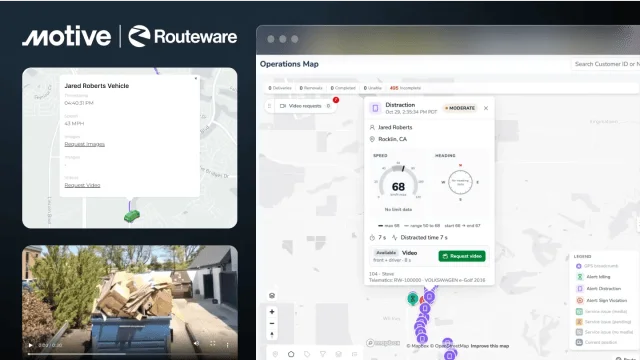
Most disputed pickups aren't really disagreements about what happened. They're searches for evidence. Route software records where a truck was supposed to go, while dashcams record where it actually went. Until now, many teams have had to stitch those two records together by hand, pulling route logs, calling drivers, and requesting video that may or may not exist.
Motive and Routeware have connected the two. Motive AI Dashcam Plus and AI Omnicam video, plus vehicle telematics, now appear inside Routeware SmartCity for municipalities and Routeware Elements for private haulers across the U.S. and Canada. Mutual customers can use the integration today.
Proof of service at the stop
A resident's call about a missed pickup, a damaged cart, or a skipped stop usually drags on because the answer lives in several places. A missed pickup can also mean a second vehicle has to go back out. That eats time, money, and goodwill. Here's what changes with the integration:
- Automatic capture at the stop. When a service-status event fires, Motive captures dashcam footage and attaches it to that stop.
- On-demand retrieval. For complaints about stops with no logged event, teams can pull a still image or a 10- to 60-second clip for any vehicle and time window, or recall video tied to a specific address.
- Resolution while the caller is on the line. Timestamped, GPS-tagged media lets customer service settle a missed or damaged pickup claim during the call.
- Durable service records. Images can be kept as records for billing disputes, contract compliance, and municipal reporting.
In practice, that means fewer return trips, faster dispute resolution, and less time spent reconstructing events nobody wrote down.
Vehicle data alongside route progress
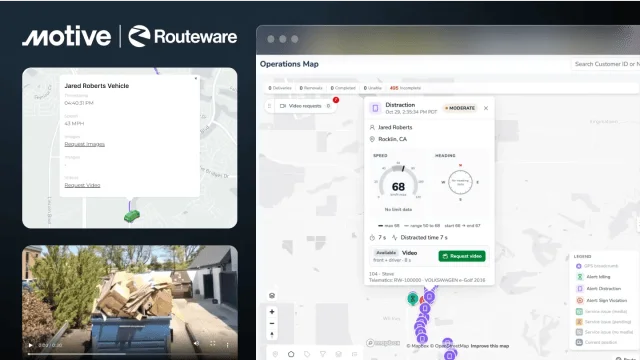
The Routeware Web Portal now also displays live GPS, safety events, fault codes, fuel data, odometer, and engine hours from Motive, next to route progress. Dispatchers get the context they need to make real-time calls. Maintenance teams can spot developing faults before they turn into breakdowns or avoidable repairs. Teams can also build historical and real-time reports that combine route and vehicle data in one view, which gives both operators and their customers a clearer picture of field activity.
Dashcam video and safety on residential routes
Refuse collection ranks among the most dangerous jobs in the United States, according to the U.S. Bureau of Labor Statistics. Trucks work residential streets and narrow alleys shared with pedestrians and other road users, and that's where sideswipes and rear-end collisions tend to happen. Telematics can tell a safety manager that a hard event occurred. Video shows what was going on around the truck.
With both systems in one place, safety teams can review events alongside route progress. When a collision or near-miss happens, they can pull the related footage without taking a driver off route or waiting days for video. That evidence also helps drivers and their employers respond to disputes and insurance claims.
- AI event detection. Motive detects more than 20 safety events, including fatigue and mobile device use, with up to 99% accuracy. The goal is to flag risk before it becomes a collision.
- 360-degree video evidence. Footage covering sideswipes through rear-end impacts can help exonerate drivers and speed up at-fault determinations.
- Collision detection. Motive detects 99% of severe collisions, including some that telematics alone can miss, and uploads video within seconds.
- Positive driving recognition. The system identifies habits such as safe following distance, so supervisors can reinforce them.
Based on internal studies and customer surveys, fleets using Motive AI Dashcams see 80% fewer accidents on average and 63% lower accident-related costs. Those figures come from Motive's own research, so treat them as a benchmark to test against your own incident history rather than a guarantee.
Revenue capture planned for 2027
Starting next year, the integration is planned to bring Motive Operations Intelligence, computer vision models trained for waste services, into Routeware. The idea is that the same screen that proves what happened can also help teams bill accurately and recover revenue they're currently missing.
- Overage Detection. AI-powered Overage Detection flags overfilled containers with visual proof and is designed to catch up to 10 times more overage events than a human operator. It's available today on Motive AI Dashcam Plus for commercial front loaders, and its Routeware integration is planned for H1 2027.
- Contamination Detection. The model flags black bags, propane tanks, and yard bags at pickup, with location and timestamp. Catching contaminants at collection gives teams a chance to educate repeat-offender residents before loads get rejected. The Routeware integration is also planned for H1 2027.
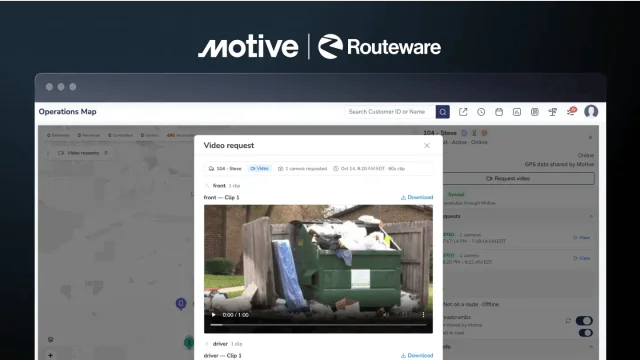
What's in the integration and who it's for
Routeware brings 25 years of experience and serves more than 1,500 customers through its system of record for routing, dispatch, billing, and resident engagement. Motive contributes its AI platform for physical operations, with cameras, telematics, and computer vision built for waste operations.
The integration covers Routeware SmartCity and Routeware Elements, with Motive AI Dashcam Plus, AI Omnicam, and vehicle telematics. Stop-level footage, on-demand stills and clips, live GPS, safety events, fault codes, fuel data, odometer, and engine hours all flow into Routeware. Overage Detection is not included yet; its integration is planned for H1 2027.
If your fleet already runs Motive and Routeware SmartCity or Elements, the integration is available through the App Marketplace. Teams that want to see how it fits their operation can contact Motive sales. The practical test is simple: the next time a missed pickup call comes in, can your team answer it before the caller hangs up?