Wednesday, November 11, 2026 · Trucking & Freight
Hapag-Lloyd Adds Direct Qingdao Calls on Two Asia-Latin America Services
Noted by Christopher Martinez · 959 reads
Hapag-Lloyd's new AMX and ASX services add direct Qingdao calls for Asia-Latin America cargo, with schedules and AS2 transition details still pending.
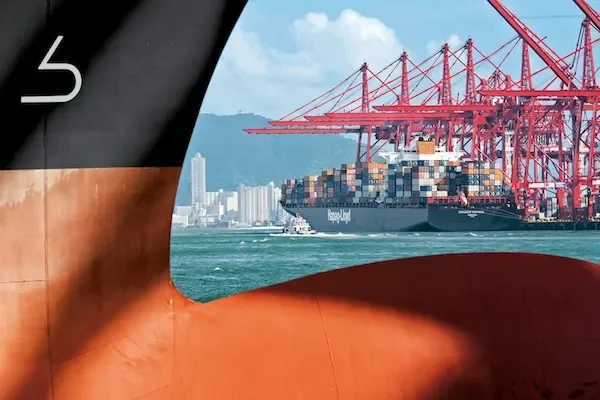
Shippers in northern China have had to route Latin America cargo through feeder legs or transshipment hubs for years. Hapag-Lloyd's two new services change that for Qingdao, at least on paper. The carrier announced on November 4 that the AMX and ASX will both call at Qingdao directly, beginning next year. Sailings haven't been published yet, so the practical effect depends on schedules that are still to come. The routing change is clear, though, and it's worth understanding before the bookings open.
The AMX: Mexico and the West Coast
The AMX links Asia with Mexico and the west coast of Latin America. Its rotation runs Ningbo, Qingdao, Busan, Ensenada, Manzanillo and Lazaro Cardenas. That's three Mexican ports on a single loop, which gives shippers a direct path into Mexico without a separate feeder. Cargo bound for other west coast destinations in Latin America will connect onward through Mexico by transshipment, so those shipments still involve a change of vessel, just not the long detour through a third-country hub.
The carrier hasn't published sailing dates. It said they will follow "within the coming days," and space allocation can only be confirmed once sailings are fixed. Forwarders planning Q1 volume should keep an eye on that timeline and avoid committing capacity on assumptions about frequency or transit time.
The ASX: South America's East Coast
The ASX runs in the opposite direction on the South American side. Its rotation is Qingdao, Ningbo, Shekou, Tanjung Pelepas, Santos, Itajai, Rio Grande, Paranagua, Santos, Singapore and back to Qingdao. Several Brazilian ports sit on the loop, including two calls at Santos, which points to a service built around Brazilian import and export volume.
Montevideo and Buenos Aires aren't on the mainline direct call list. Hapag-Lloyd says they'll be served through a feeder connection from Rio Grande, which the announcement describes as the service's "River Plate connectivity" provision. For shippers whose consignees sit in Uruguay or Argentina, that means a feeder leg is still part of the journey. The transit comparison against a direct call will matter, so it's worth asking the carrier for specifics once the feeder schedule is out.
First sailing date, booking arrangements and the transition plan for cargo migrating from AS2 will be communicated separately before the service starts. That's a lot of open items for a service that hasn't yet been scheduled.
What the Qingdao call changes for northern China exporters
Here's the thing: the Qingdao call is the real news for Shandong and the surrounding hinterland. Exporters in that region have typically consolidated cargo inland to southern hubs, or accepted a feeder connection, before the ship leaves for Latin America. A direct call removes at least one of those steps. Less inland movement and fewer transfers usually mean fewer chances for missed connections, and a shorter path tends to make schedule reliability easier to plan around.
That said, the gain is only as good as the sailing frequency and the cutoffs. A direct call on a service that sails every few weeks offers less flexibility than a feeder option with more departures, even if the transit time is shorter. Shippers should compare the two once the schedules are published, not before.
The AS2 question
Hapag-Lloyd has positioned the ASX in relation to the existing AS2 service, but the announcement doesn't confirm that the ASX replaces it. It also doesn't include a transition plan. Customers with long-term contracts or bookings on the East Coast South America trade for the second quarter of 2027 and beyond shouldn't assume continuity between the old and new services until the carrier confirms it in writing.
Contract teams should check how their agreements handle service changes, vessel substitution and transshipment liability. Those clauses decide who carries the risk if a sailing moves, a vessel changes or cargo ends up on a different rotation than the one booked. Waiting for the formal transition notice before acting is the safer route here.
The wider East Coast South America picture
Hapag-Lloyd currently runs a joint Asia-East Coast South America service with MSC and ONE. Both MSC and ONE have said they'll operate independently from April 2027. Put that next to the two new Hapag-Lloyd services, and three carriers are reshaping their East Coast South America networks inside the same window.
That kind of convergence usually signals more than one-off schedule tweaks. Carriers tend to reset capacity when a shared service ends, and the new rotations will show how each one intends to cover the trade. Vessel names and deployed capacity for both new Hapag-Lloyd services haven't been disclosed yet, and those figures will say a lot about how much room each service actually adds on the lane.
For now, the practical move is to map which of your Latin America lanes start from northern China, identify the consignees on the Mexican and South American side, and get ready to compare direct and feeder options as the sailing schedules land. The routing change is real. The details that decide whether it helps your cargo are still to come.