Monday, November 23, 2026 · Trucking & Freight
Lufthansa Cargo to Take Direct Control of Fiege’s Frankfurt Cargo Handling
Noted by Eric Kulisch · 822 reads
Lufthansa Cargo plans to bring Fiege’s Frankfurt operation under direct management, adding to its handling capacity and warehouse modernization work.
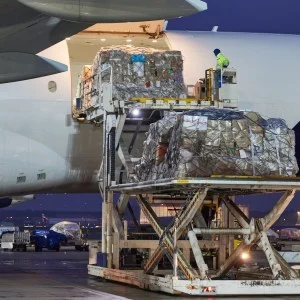
Lufthansa Cargo plans to take direct control of Fiege Air Cargo Logistics’ Frankfurt operation, adding a second cargo handling business at its largest hub to its own organization within three weeks. The move puts more of the transfer from truck to aircraft under Lufthansa Cargo’s management as it invests in warehouse capacity, systems and automation.
The planned purchase follows Lufthansa Cargo’s Nov. 2 acquisition of LUG air cargo handling GmbH, also at Frankfurt. Together, the deals give the carrier a larger direct role in cargo handling at the airport while preserving an ongoing working relationship with Fiege. Financial terms were not disclosed, and the Fiege transaction remains subject to customary review.
More control over hub operations
Fiege Air Cargo has handled Lufthansa’s physical cargo operations in Frankfurt since 2020. The company also operates at Cologne/Bonn and Zurich airports and belongs to logistics group Fiege Logistik Stiftung & Co. KG. After the transaction, it is expected to continue supporting Lufthansa Cargo with recruitment, training and specialized warehouse staff.
That continuing role matters operationally: the ownership change brings the Frankfurt handling operation under Lufthansa Cargo’s management while retaining Fiege’s personnel services and expertise. Lufthansa Cargo says the shift will give it a more direct hand in running the facilities and make it easier to introduce technologies and automate warehouse work.
Frankfurt is the most important hub in Lufthansa Cargo’s network, according to Frank Bauer, the company’s chief operations officer. He described direct responsibility for handling as a way to improve quality and efficiency as the company develops its infrastructure and warehouse systems. The company also said it intends to continue its cooperation with Fiege over the long term on a new basis.
For shippers, the operational question will be how the change affects cargo transfers, warehouse processes and service consistency at Frankfurt. Bringing handling closer to the carrier’s own management could reduce handoffs between separate operators. The company’s stated aim is to pair that control with faster technology deployment and automation; it has not provided a timetable or specific service measures for those changes.
Part of a wider Frankfurt buildout
LUG adds warehouse capacity and operational flexibility at Frankfurt. It will continue to operate under its own brand within Lufthansa Cargo and serve customers beyond the airline. Lufthansa Cargo has appointed veteran manager Uwe Glunz and LUG managing director Patrik Tschirch as LUG’s co-CEOs.
The handling acquisitions sit alongside a larger cargo terminal expansion and modernization project at Frankfurt, valued at $682 million and scheduled for completion in 2030. The additional capacity from LUG complements that infrastructure work, while the planned Fiege purchase would bring another part of the hub’s cargo handling into direct management.
The changes also fit Lufthansa Cargo’s aim of returning to the top three global air cargo providers by 2030. The company has described its broader priorities as developing its core business, expanding capacity, improving efficiency and automating operations. It also merged heyworld, which focuses on expedited cross-border e-commerce shipments, and CB Customs Broker into GlobeCross GmbH earlier this year.
Network scale and recent results
Lufthansa Cargo ranked No. 14 among global carriers by traffic volume, according to the International Air Transport Association. Its fleet includes 12 Boeing 777 freighters. It can also market capacity on six Boeing 777 freighters operated by AeroLogic, its joint venture with DHL Express, giving it access to 18 widebody freighters. The company additionally sells cargo space in the passenger aircraft of Lufthansa Airlines, Austrian Airlines, Brussels Airlines, Discover Airlines and SunExpress.
In the third quarter, Lufthansa Cargo reported operating profit of 162 million euros, equivalent to $177 million, three times the year-earlier amount. Core transportation revenue rose 28%, and yield increased 22%. The company attributed the yield rise to reduced industry capacity and higher jet fuel prices. Demand was particularly strong in Asia/Pacific and the Americas. Its adjusted operating margin reached 15.6%, compared with 6% in the comparable period.
Those results provide context for the investment program, but they don’t establish how much either handling acquisition will contribute. For customers using Frankfurt, the practical measure will be whether direct operational control, new warehouse systems and added capacity translate into more predictable handling as the terminal project advances toward 2030.