Wednesday, October 14, 2026 · Ocean Shipping & Ports
Motive’s Fleet Software Rankings Pair Multi-Season Results With Customer ROI
Noted by Motive · 418 reads
Motive leads several G2 and TrustRadius rankings, while customer reports cite faster setup and payback. Compare results by report type and fleet size.
Motive’s repeated rankings on G2 and TrustRadius are most useful when read alongside the measures behind them: customer satisfaction, implementation time, reported returns and the size of the reviewers’ organizations. The company says it has led several fleet categories across multiple reporting periods, while customer examples describe deployments and savings in operational terms.
For fleet buyers comparing software, a single “No. 1” badge can be hard to interpret. G2 publishes separate reports for fleet management, fleet tracking and asset tracking, with results divided by report type and company size. More than one provider can therefore lead a category in a given quarter, depending on the report and measure. Comparing the same report type, segment and metric over time gives buyers a clearer basis for evaluation.
What the review rankings measure
G2’s reports assess different parts of a product’s performance. Its scoring methodology distinguishes among customer feedback, market signals and implementation or results measures.
- Grid reports plot satisfaction and market presence. Satisfaction draws on user ratings for ease of use, support quality and likelihood to recommend. Market presence includes review volume and external signals such as employee counts and web traffic.
- Momentum Grid reports focus on growth and traction, including year-over-year changes in employee count, review volume, social following and web presence.
- Implementation Index reports assess time to go live, setup, implementation experience and user adoption.
- Results Index reports consider whether a product meets requirements, user adoption, estimated return on investment and likelihood to recommend.
- Relationship Index reports measure ease of doing business, support quality and likelihood to recommend.
G2 also groups reviewers by the size of their employer: enterprise means 1,001 or more employees, mid-market covers 51 to 1,000, and small business covers 50 or fewer. Those headcount bands won’t map neatly to fleet size for every provider, so buyers should check which customers contributed to a result.
G2 normalizes scores on a 0-to-100 scale against other products in the same category. A 99 satisfaction score, for example, reflects a product’s standing against that category’s competitors. TrustRadius uses a separate approach: its Buyers Choice award draws on customer feedback about capabilities, value and customer relationships.
Motive’s reported ranking record
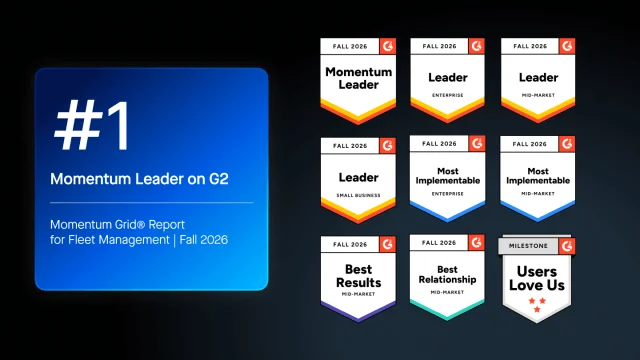
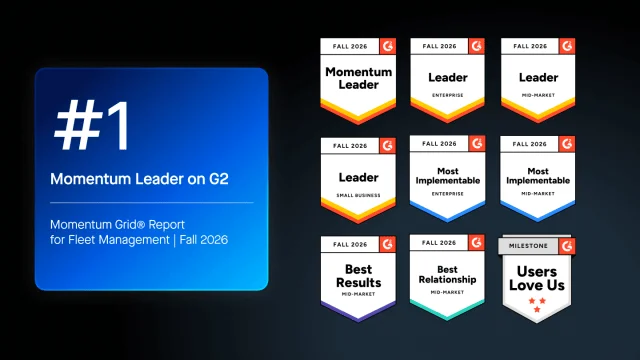
In G2’s Fall 2026 results, Motive ranked first on the Fleet Management Momentum Grid for the ninth consecutive quarter, with a score of 90 compared with Samsara’s 84. Because that grid combines review activity with social, web and employee signals, the sustained run indicates continuing traction across those measures. Motive’s Fall 2026 rankings also include first-place Momentum Grid results in trucking and fleet tracking, as well as first-place Implementation Index results in fleet management, fleet tracking and mid-market asset tracking.
The company reports a 99% satisfaction score in G2’s fleet management category. On TrustRadius, Motive has ranked first for fleet management for four consecutive years and received the site’s Buyers Choice and Top Rated awards in 2026. These results come from different sites and scoring systems; buyers should read each one alongside its stated category and criteria. Motive’s account of its G2 and TrustRadius results provides further detail.
Reported payback and implementation times
G2 reviewers reported relatively short payback periods for Motive across several reports. In the Winter 2026 Enterprise Grid Report for fleet management, the average estimated payback was five months, compared with 11 months for Samsara and 17 months for Lytx, according to Motive’s report on the results.
The Winter 2025 fleet management reports showed a similar pattern: Motive customers reported recovering their initial investment in six months on average. Motive said that was 40% faster than the period reported by Samsara customers and nearly 65% faster than Lytx customers. Its satisfaction scores in those reports also exceeded Verizon Connect’s in the enterprise and mid-market segments, as described in the company’s Winter 2025 results.
In G2’s Summer 2026 Enterprise Results Index for asset tracking, Motive customers reported an estimated return in 3.55 months. The corresponding figures were 8.85 months for Samsara and an 11.41-month category average. In the Fall 2026 Enterprise Results Index for fleet management, Motive customers reported 5.7 months, compared with 9.44 months for Samsara. Motive’s Summer 2026 asset tracking results and Fall 2026 rankings give the report context.
G2’s implementation figures also show shorter reported setup periods in several segments. Enterprise fleet management customers averaged 2.6 months to go live in Winter 2026, versus 3.6 months for Samsara and 4.2 months for Lytx. In Summer 2026, the enterprise fleet management averages were 2.52 months for Motive and 3.34 months for Samsara. Enterprise asset tracking customers reported 1.84 months for Motive, compared with 3.12 months for Samsara and a 3.53-month category average.
In Fall 2026, Motive ranked first on G2’s Fleet Tracking Implementation Index. Customers reported an average go-live time of 1.67 months and an ease-of-setup score of 90%. One safety manager described the potential return in a G2 review: “If the current trend holds true, we have paid for the three-year commitment in less than 6 months.” The reviewer also reported a 50% decline in slow-speed, fixed-object collisions within the first few months.
A separate study offers another reference point, though its sample was small and the study was sponsored by Motive. Analyst firm IDC interviewed six organizations using the company’s AI-powered safety tools. The organizations reported a five-month payback, more than eight times return on their safety investment and average annual safety savings above $1.8 million. Details appear in the IDC findings.
Customer examples add operational detail
Motive’s published customer stories describe installation work and reported results behind the review scores. At EnerCorp, in-house mechanics installed AI Dashcams in 220 vehicles in 90 days. All Chemical Transport COO Anthony Coruccini said the company handled installations in-house in about 20 minutes per truck, saving $52,000 in installation costs and at least 180 hours.
Customer accounts also describe the service experience. One asset and fleet manager said in a G2 review shared by Motive that the sales, implementation and account management teams made the process easy. The observation is individual feedback, but it speaks to a practical consideration for fleet managers: rollout depends on both the equipment and the support available during deployment.
Reported financial and safety outcomes vary by customer. Ernst Concrete Director of Risk and Safety Paul Fly said the company saved about $1.3 million a year in direct losses, or about $6.5 million when downtime, employee injuries and legal expenses were included. He calculated that as a 2,000% return, in a Motive ROI report. Smart Chemical Solutions reported that rebates rose from $486.90 on $3.4 million in spend with its previous card provider in 2022 to a monthly average of $4,879. FusionSite Services reported a change from 76 claims in one year with 479 vehicles to one claim year to date across more than 1,000 vehicles, also cited in the Smart Chemical Solutions case study and Motive ROI report.
Fleet buyers can review customer feedback on G2 and TrustRadius, and see the findings from 351 organizations in the 2026 Motive ROI Report. The key is to compare like-for-like results and check whether the reported setup times and returns fit the fleet’s own operating needs.
Methodology: G2 rankings and scores cited here are from the report types and seasons named above, including Winter 2025, Winter 2026, Summer 2026 and Fall 2026. Momentum Grid reports combine review activity with social, web and employee data; Grid and index reports draw on verified-user reviews. TrustRadius awards cited are its 2026 Buyers Choice and Top Rated awards. Reviews are public on G2 and TrustRadius; individual experiences vary. The IDC findings are from a study sponsored by Motive Technologies, Inc., “The Business Value of Motive’s Accurate AI for Fleet Safety,” Doc #US54413826-BVWP, May 2026, based on interviews with six organizations. See the IDC white paper.


