Monday, October 19, 2026 · Trucking & Freight
Suez Canal Return Gains Pace as Carriers Weigh Time and Fleet Capacity
Noted by Joseph Davis · 942 reads
Drewry says Suez cuts Asia–North Europe round trips by 27 days, while insurance costs could outweigh estimated voyage savings.
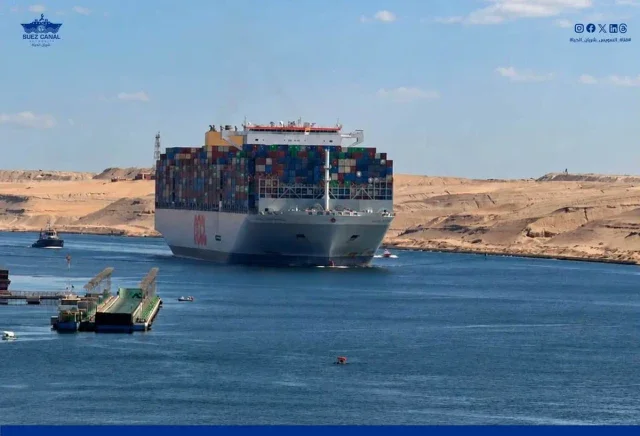
For container lines weighing a return to the Suez Canal, the strongest case is measured in days and vessel capacity, not a large reduction in voyage costs. Drewry Maritime Research estimates that a 24,000 TEU ship saves about $1 million per round voyage by using Suez instead of sailing around the Cape of Good Hope. But insurance premiums could erase that saving, and the resulting economics may not translate into major freight savings for cargo owners.
Drewry published its assessment on October 8, 2026, as major operators began restoring canal services despite unresolved Red Sea security threats. The report points to shorter journeys, more productive fleet deployment and competitive pressure as the main forces behind the shift. Canal pricing and insurance remain key variables in whether a particular voyage makes financial sense.
Time savings dwarf the cost reduction
Drewry’s September 2026 comparison of Asia–North Europe services puts the difference in route length at about 7,833 nautical miles per round trip. A Suez voyage covers approximately 21,878 nautical miles, compared with 29,711 nautical miles via the Cape of Good Hope.
The shorter route cuts the estimated round voyage from 124 days to 97 days, a 27-day reduction. By comparison, operating costs fall from an estimated $18 million to $17 million per voyage, or roughly 6%. That makes the route attractive for schedule and fleet reasons even when its direct cost advantage is limited.
A vessel that spends fewer days completing a rotation can potentially make more voyages in a year. Carriers may therefore be able to maintain weekly sailing frequencies with fewer ships assigned to a service. For operators managing vessel availability across multiple routes, that added flexibility can matter more than the savings on one trip.
The shorter passage can also help carriers offer faster delivery schedules. Shippers managing inventory, customer commitments and narrow delivery windows may value the time reduction, although the report does not quantify any resulting change in freight rates or cargo owners’ total costs.
Insurance can reverse the voyage calculation
The estimated $1 million saving does not include war-risk insurance or possible discounts on canal fees. Insurance is charged as an additional premium for vessels entering designated risk areas, with the amount calculated as a percentage of the ship’s hull value.
For a containership valued at $225 million, Drewry estimates that a 0.3% premium on hull value would add $1.35 million for two passages through the risk area. At a 1% premium, the additional charge would reach $4.5 million. Even the lower estimate exceeds the voyage saving before other reductions are considered.
Discounts on canal fees could narrow the gap. Drewry estimates that a 15% reduction would save about $365,000 across two transits; a 25% reduction would bring the saving to around $600,000. Those amounts would offset part of the insurance bill, but the report’s figures show how strongly the route decision depends on the price of coverage and canal access.
For cargo owners, the practical takeaway is that a faster route does not automatically mean a materially cheaper shipment. The voyage-level figures do not establish how carriers will price individual services, and route economics can vary with insurance premiums and discounts. Shippers evaluating schedules should pay attention to the service actually used and the transit time offered, rather than assuming the canal’s operating-cost reduction will flow directly into lower freight charges.
Carriers are restoring services in stages
Drewry identifies services operated by MSC, CMA CGM, Maersk, the Ocean Alliance and the Gemini Cooperation among those returning to the canal. The initial moves have been measured: many services use Suez only on eastbound backhaul voyages, the return leg from Europe to Asia that typically carries lower cargo volumes. Other services have resumed passages in both directions.
That staged approach allows operators to adjust routes while the insurance and security picture remains uncertain. It also means that a carrier’s return to Suez may not apply uniformly across every service or direction. Shippers should check the routing and schedule of the specific service carrying their cargo.
The Cape route’s longer distance can expose schedules to weather-related disruptions, while Suez offers a shorter rotation and potentially quicker delivery. Drewry’s analysis suggests that these operational considerations, along with the ability to use vessels more efficiently, are strengthening the commercial case for a return.
Competitive pressure could speed that process. If one carrier offers shorter transit times at comparable freight rates, rivals may face pressure to restore their own Suez services to remain attractive to customers. The next signal for shippers will be how broadly carriers extend canal routings beyond selected backhaul voyages, and whether insurance and canal pricing allow those faster schedules to hold.


