Friday, October 30, 2026 · Ocean Shipping & Ports
Ten Early Submarines That Shaped Underwater Vessel Design
Noted by maritimecyprus · 865 reads
From hand-cranked boats to electric propulsion, ten early submarines tested the systems and tactics that shaped undersea travel.
Early submarines were experiments in staying alive underwater as much as they were attempts to travel beneath the surface. Across three centuries, inventors tried hand cranks, treadmills, compressed air, gasoline engines and electric motors. Their vessels ranged from one-person attack craft to boats built for long-distance voyages. Several failed their intended missions; others demonstrated ideas that later submarine designers would develop further.
The following ten craft trace that progression, from a rumored dive beneath the Thames to a submarine adapted to carry an aircraft.
Drebbel’s diving boat, around 1620
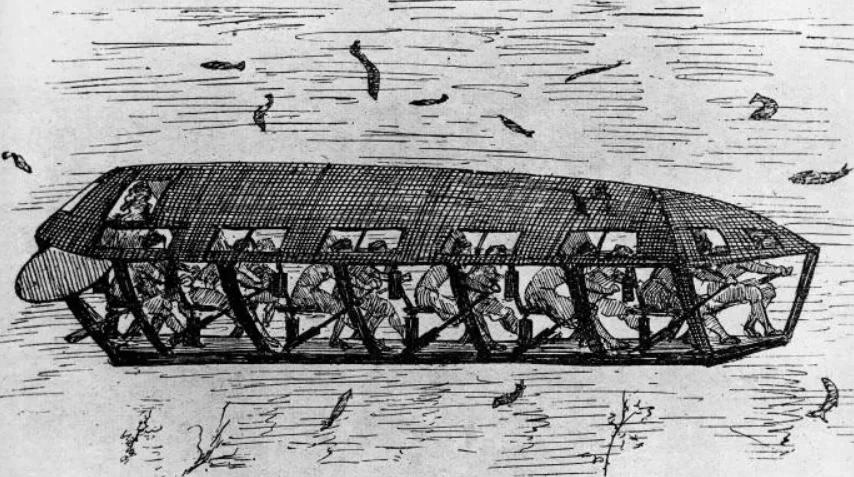 Illustration of a Drebbel.
William Bourne, an English mathematician, drew up some of the earliest known submarine plans around 1578. The first working prototype came later, built by Dutch inventor Cornelius Drebbel while he served King James I of England. The craft was likely a modified rowboat covered in greased leather, with oarsmen providing its power.
Drebbel reportedly took the boat about 15 feet beneath the River Thames around 1620, in a demonstration watched by the king and crowds in London. No plans or engineering drawings survive, leaving the method of diving uncertain. Some accounts describe bladders or wooden ballast tanks; others suggest the boat used a sloping bow and weights to descend while moving forward under oar power.
Turtle, 1775
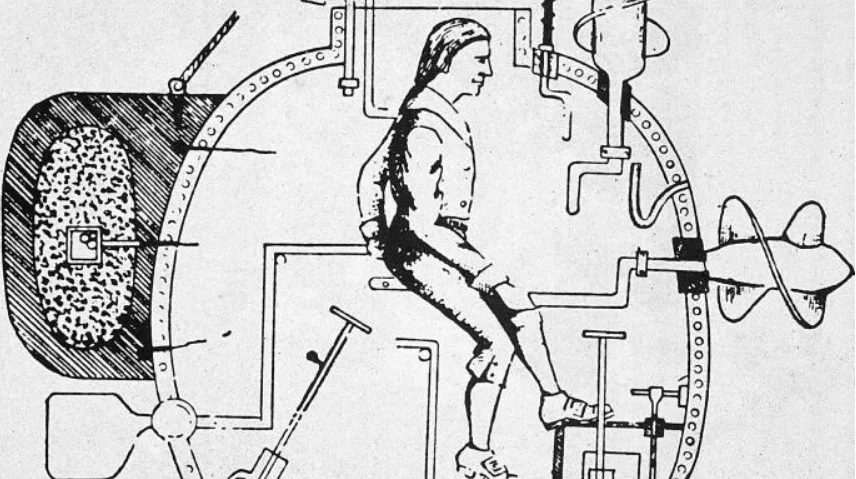
David Bushnell, a Yale graduate and inventor, designed the one-person Turtle during the American Revolution. A hand crank and foot treadle turned its propeller. The operator used a pedal-operated water tank to dive or surface, while lead ballast helped keep the craft upright. Its planned attack involved approaching a ship underwater and fastening a screw-mounted mine carrying 150 pounds of gunpowder to the hull.
On September 7, 1776, Continental Army soldier Ezra Lee piloted the Turtle beneath the British warship HMS Eagle in New York Harbor. He couldn’t attach the timed explosive and instead abandoned the attempt, detonating the mine in open water. Other missions also failed to sink an enemy ship, and Bushnell eventually gave up the project. The concept still drew respect: George Washington later called it “an effort of genius.”
Nautilus, 1800
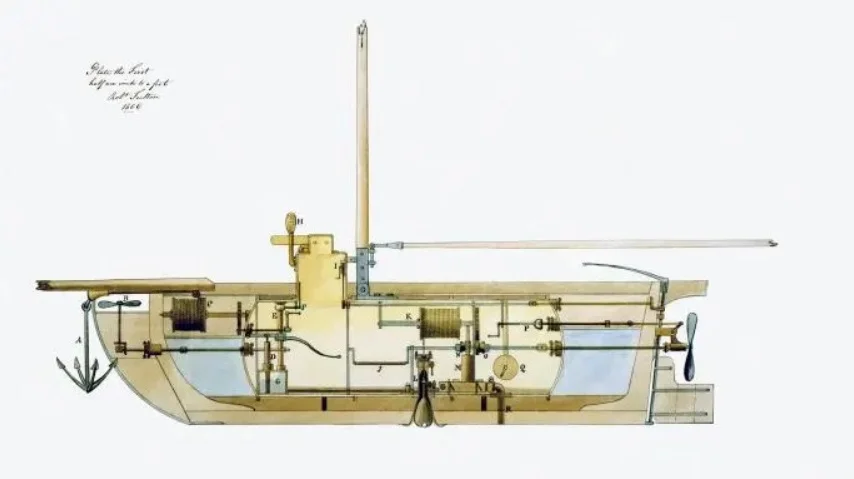 Cross-section of a Fulton-designed submarine.
American inventor Robert Fulton designed the 21-foot Nautilus while working for France. Its all-metal hull, cigar-like shape and copper conning tower set it apart from earlier diving boats. Underwater, a hand-powered, four-bladed propeller drove the craft. At the surface, the crew could use a collapsible mast and fan sail. Diving planes helped it submerge, and Fulton tested copper bottles for storing compressed air to supply oxygen.
The Nautilus completed several successful test dives but failed to win support from either the French or English navies. It was dismantled and sold for scrap. Fulton later returned to the United States and became known for developing a commercially viable steamboat.
Sea Devil, 1855
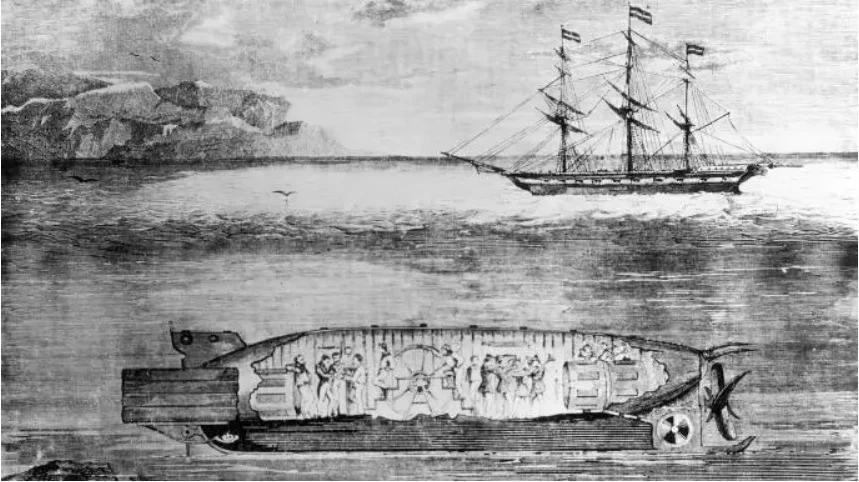 Drawing of the Sea Devil on the ocean floor.
Bavarian inventor Wilhelm Bauer had a close call in 1850 when his first submarine sank during a demonstration in 50 feet of water. He continued his work and secured Russian funding for a second vessel. Built in St. Petersburg in 1855, the 52-foot Sea Devil carried up to 12 people.
Multiple ballast tanks helped control buoyancy, and a basic airlock was among its features. Crew members powered the propeller by walking on an internal treadmill. The boat reportedly completed more than 130 dives before it was lost at sea. Its most unusual outing came at the coronation of Czar Alexander II: four musicians went underwater aboard the craft, and witnesses said they heard a performance of the Russian anthem from below the surface.
CSS H.L. Hunley, 1863
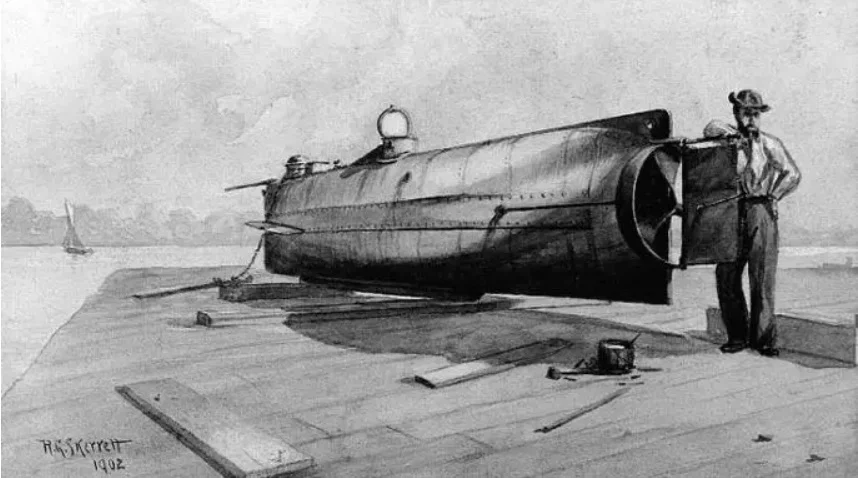 Drawing of Hunley on a pier.
Built privately in Mobile, Alabama, the H.L. Hunley was intended to break through Union sea blockades during the Civil War. Its hull was made from a recycled iron steam boiler. Eight crew members operated it: one steered, while seven turned hand cranks connected to the propeller. A 17-foot spar at the bow carried a torpedo designed to explode when driven into a target.
The boat sank twice during trials, killing 13 crew members in total, including its namesake, marine engineer Horace Lawson Hunley. After it was raised and returned to service, Lieutenant George Dixon and a volunteer crew took it into Charleston Harbor on February 17, 1864. Its torpedo struck the sloop-of-war USS Housatonic, which sank within minutes. The Hunley also went down, possibly damaged during the attack. Its crew perished, even as the mission marked the first time a submarine sank an enemy ship.
Le Plongeur, 1864
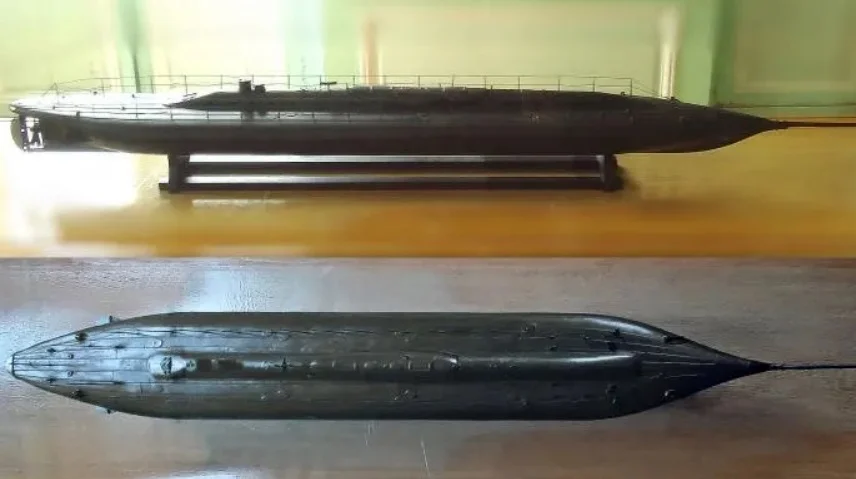 Model of Le Plongeur.
French naval officers Simeon Bourgeois and Charles Brun designed Le Plongeur, or “The Diver,” as an early mechanically powered submarine. The 140-foot vessel used a piston engine driven by compressed air stored in tanks. That air also supplied the crew with oxygen and helped empty the ballast tanks.
The system replaced the human-powered cranks, pedals and treadmills used by earlier craft, but its air supply was limited and its structure proved dangerously unstable. After several dives, Le Plongeur left active service in 1872. France’s later Gymnote, built in 1888, addressed some of its shortcomings with a more maneuverable design and electric propulsion.
Ictineo II, 1865
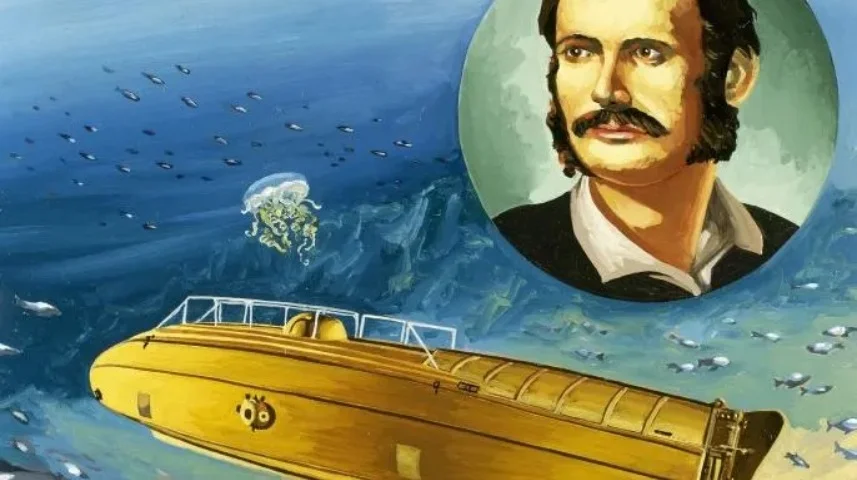 Drawing of Monturiol and his submarine.
Spanish inventor Narcís Monturiol i Estarriol began designing underwater craft after witnessing a coral diver drown in 1857. He wanted to make underwater work safer. His 46-foot Ictineo II followed an earlier diving boat, Ictineo I, and used a double hull with four pump-operated ballast tanks and a system of weights for stability.
Monturiol developed an anaerobic steam engine that used a chemical reaction to generate heat and oxygen. The boat made a successful dive in late 1867, but financial difficulties led to its sale for scrap. The propulsion system would not be replicated until the 20th century.
Argonaut, 1897
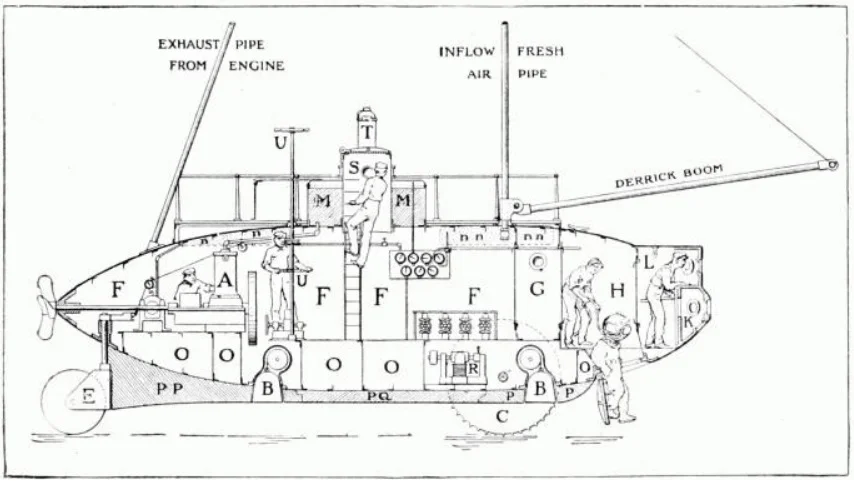 Argonaut I drawing.
By the late 19th century, most submarines could only make short trips near shore. American engineer Simon Lake’s 36-foot Argonaut extended that range. Powered by a 30-horsepower gasoline engine, it had wheels for moving along the seabed, as well as a periscope, diving chamber and floating air hose for the engine and crew.
Lake first used it to salvage wrecks in Chesapeake Bay. In 1898, he sailed it from Norfolk, Virginia, to Sandy Hook, New Jersey, in a voyage described as the first open-ocean journey by a submarine. The trip brought him wide recognition and a congratulatory letter from author Jules Verne. Lake later developed dozens of underwater craft and received more than 200 patents.
USS Holland, 1898
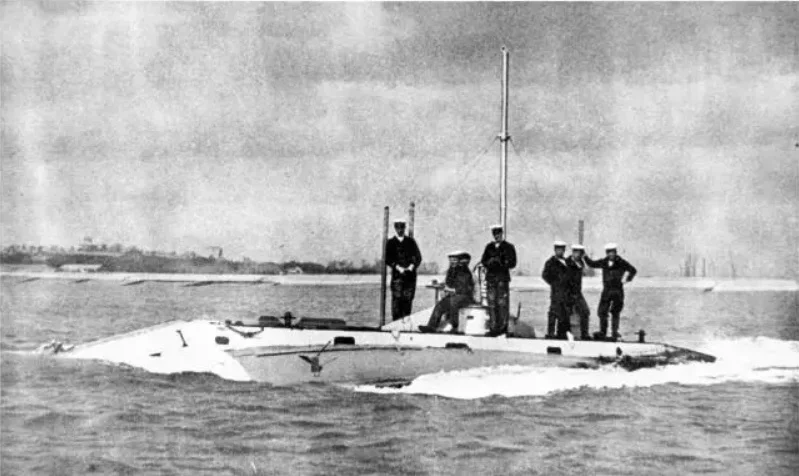 Photo of the Holland at sea.
Built in 1898, the 54-foot Holland became the first submarine commissioned by the U.S. Navy at a ceremony in Newport, Rhode Island, on October 12, 1900. It was named for its inventor, Irish-born engineer John Philip Holland. Its weapons included one torpedo tube and a pneumatic cannon called a “dynamite gun.”
A four-cylinder gasoline engine powered the boat on the surface; a 160-horsepower electric motor drove it underwater. Holland never saw combat, serving instead as a training and experimental vessel for the Navy’s first submariners. By the time it was retired in 1905, six other attack submarines had entered service.
HMS M2, 1919
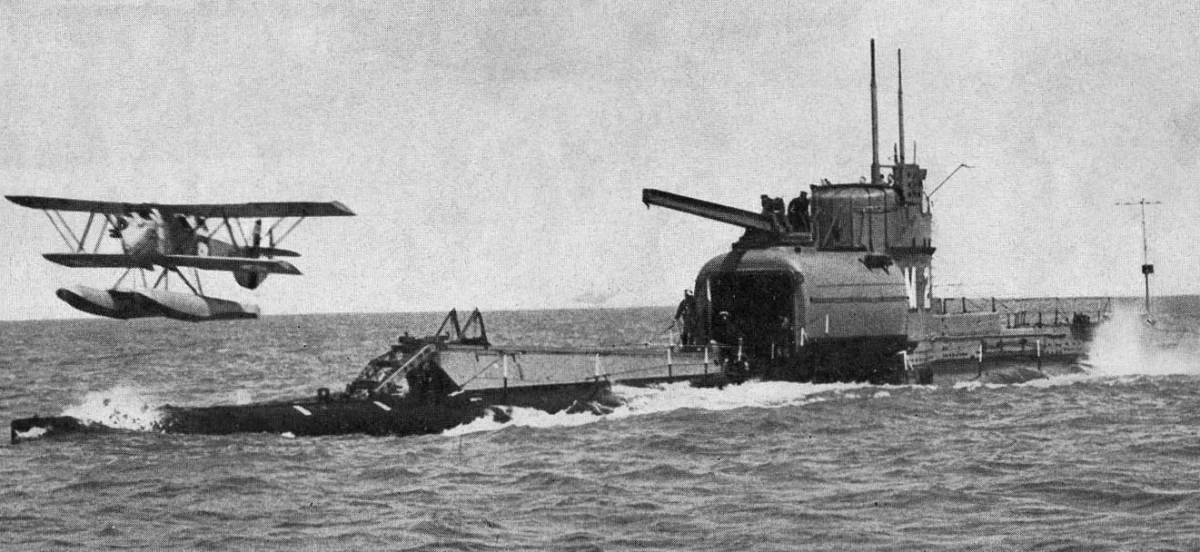
Completed in 1919, HMS M2 was one of three M-class submarines. In 1927, it was converted into a submarine aircraft carrier, adding a new role to the range of work an undersea vessel could perform. The boat was wrecked in Lyme Bay, off Dorset, Britain, on January 26, 1932.
Together, these ten designs show submarine development as a sequence of practical tests: how to control buoyancy, supply air, move underwater and extend a vessel’s range. Their varied propulsion and operating systems reveal how quickly inventors moved from human power toward engines and electric motors.


