Sunday, November 15, 2026 · Trucking & Freight
Truckload spot rates climb early as holiday freight arrives ahead of schedule
Noted by Zach Strickland, FW Market Expert & Market Analyst · 440 reads
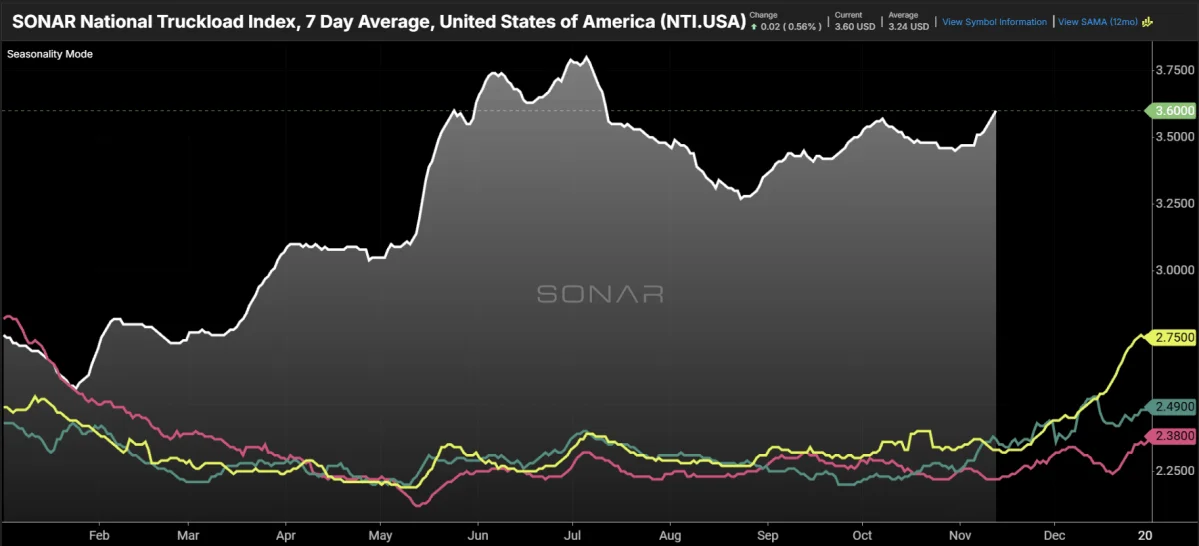
The NTI dry van spot index hit its highest level since July in early November. Fuel doesn't explain the move; shippers pulling freight forward does.

The National Truckload Index hit its highest level since July in early November, and that's early for spot rates to climb ahead of the holidays. The NTI tracks dry van spot rate movement across the U.S. and is published through SONAR. The index rarely runs this hot this soon, so the real question is what's pulling it up.
Fuel doesn't fit the timeline
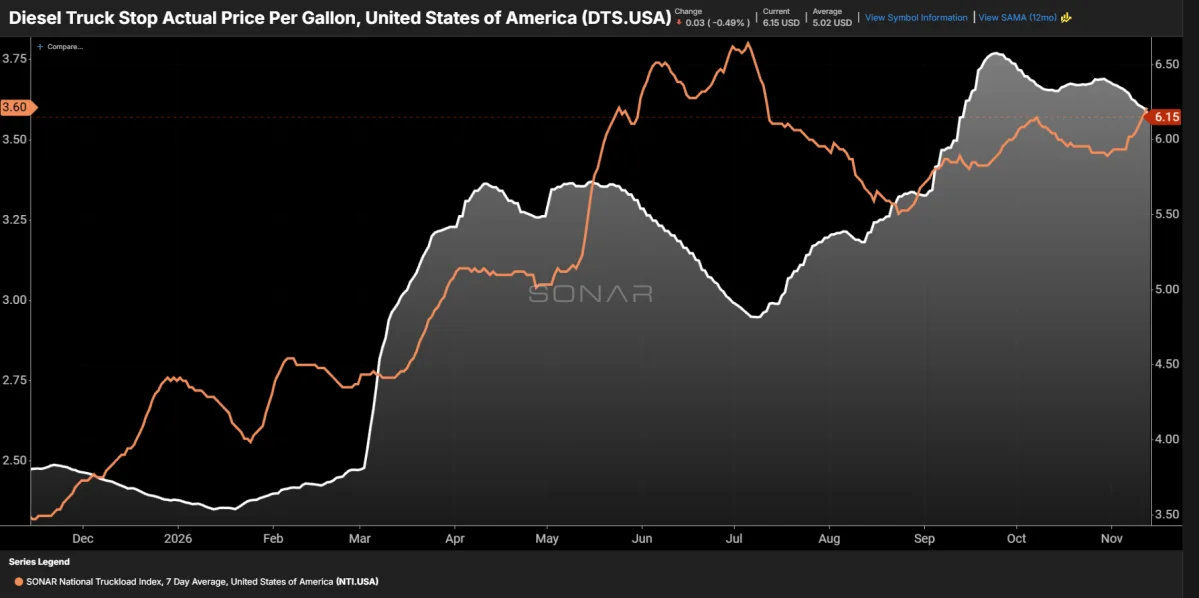
Fuel is the first explanation most people reach for, and it's a fair thing to check. Higher diesel costs can account for some of the year-over-year gain in the index and the wider gap between spot and rejection rates this fall. They don't explain this particular jump very well, though. The NTI includes fuel, and diesel has fallen roughly 3.5% since late October. Over that same stretch, the index rose more than 4%. When the input cost goes one way and the index goes the other, pass-through isn't the story.
Timing matters too. Fuel feeds into rates with a lag of a few weeks, and diesel hasn't seen a sharp increase since early September. That's well outside the window that would explain a move this week. Carriers also can't push cost increases onto shippers unless the market will bear them. Anyone who has tried to pass supplier inflation along to a customer knows how that goes. My read is that this rise is being set by demand conditions, not by what diesel is doing.
The capacity signals don't line up
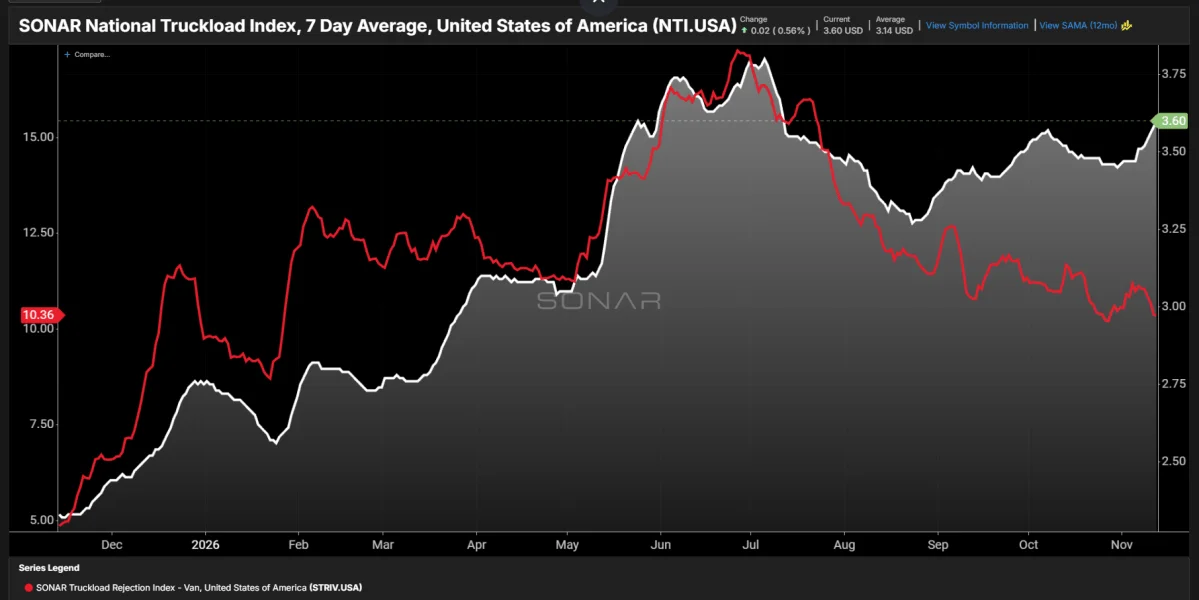
Here's what makes this harder to read. If spot rates were rising because trucks were getting scarce, tender rejections would be climbing alongside them. They aren't. National dry van rejection rates have trended lower since July, though they remain elevated. Rejections above 10% still signal insufficient capacity, so the market isn't loose. But a falling rejection rate next to a rising spot index is a split signal, and it deserves attention.
Part of the explanation is that the two measures cover different freight. Tender data reflects the much larger contracted market. Spot freight accounts for roughly 10% to 25% of truckload volume, depending on the market, and it can move on its own schedule. That gap is why the two indicators can diverge for a stretch before they converge again.
Freight is bypassing contracts
The likeliest source of the disconnect is a wave of freight moving outside contract agreements and into the spot market. On a recent Freightonomics episode, Dr. Zac Rogers, co-author of the Logistics Managers' Index (LMI), said many retailers appear to have waited until the last minute to bring inventory into the country.
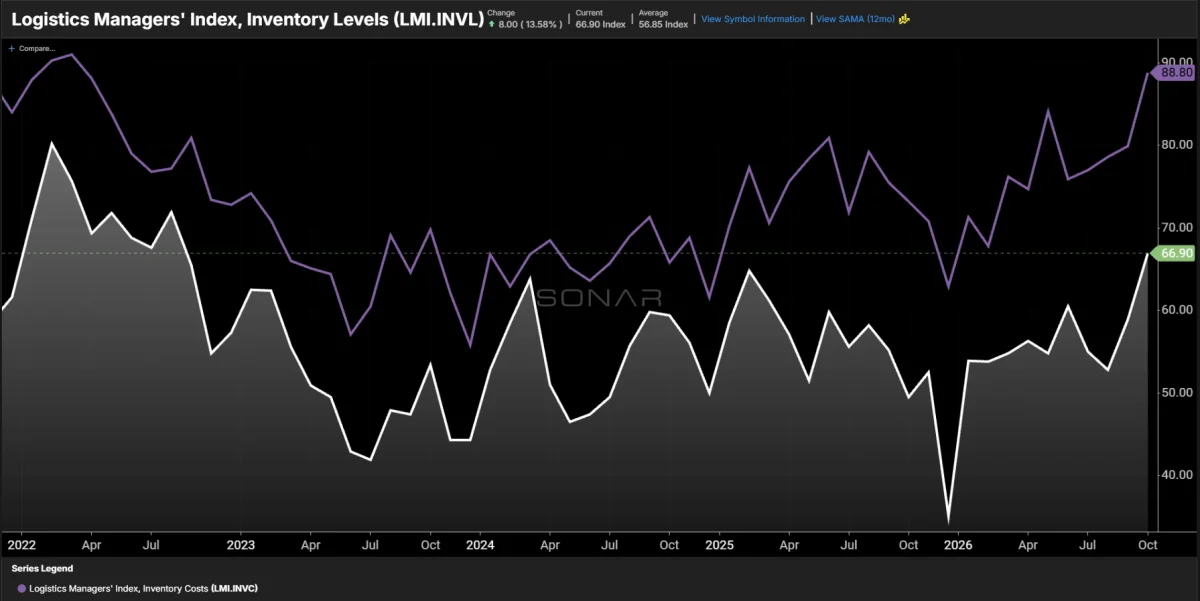
The October LMI backs that up. Its inventory levels component came in at 66.9, the highest reading for that measure since 2022. Rogers tied the late surge to three forces: demand uncertainty, rising inventory holding costs, and leaner supply chains.
Why waiting became the cheaper bet
Demand uncertainty has defined 2026 for many retailers, who expected consumers to pull back as inflation lingered. That pullback has hit some categories harder than others, but in aggregate it has largely washed out. The result is buyers who still aren't sure what to order or when.
Holding inventory has gotten expensive, and that changes the math. Shippers have leaned into just-in-time ordering, and it has worked well for them. When carrying stock costs this much, the premium for shipping later looks easier to justify. Intermodal has been a beneficiary here, growing by double digits over 2025 levels as trucking and warehousing costs stayed elevated.
Rogers also pointed to how supply chains have changed since COVID. Networks are more streamlined and flexible now, so shippers can move freight through them more precisely, cut transit times, and hold orders back longer. That flexibility lets a retailer wait, then compress a large volume of movement into a short window.
With the holidays approaching and the truckload market still not fully recovered, waiting until the week before Thanksgiving is likely to cost more. Some shippers are clearly trying to get ahead of that.
Rail disruptions and container volumes
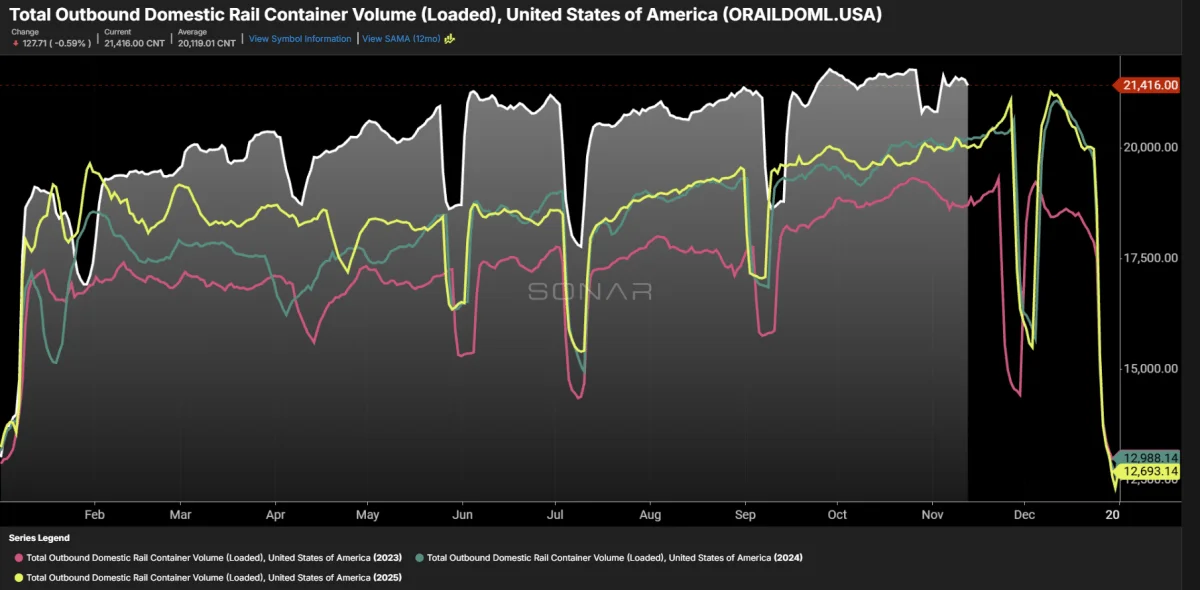
Some of this freight may be coming off rail. Disruptions affecting BNSF and CSX in recent weeks could be pushing volume back to truck. Domestic container volumes haven't fully recovered either, and they appear to be running into a ceiling. In the previous two years, domestic container volumes kept growing into December. This year that pattern isn't showing up yet, which is worth watching as the peak season builds.
What to watch into the holidays
Watch whether rejection rates start moving up with spot rates. If they do, the contract market is catching up and the tightening is broader. If spot keeps climbing while rejections stay flat, the increase is concentrated in the non-contract freight that holiday shippers are pushing forward. The LMI inventory readings will show whether the late surge is continuing or running out of steam. For shippers planning peak, the practical question is whether to secure capacity now or wait and accept the spot premium that comes with it.