Friday, October 23, 2026 · Ocean Shipping & Ports
SCOUT Bags Handles Four Annual Peaks With Flexible Fulfillment at Barrett
Noted by Thomas Jones · 629 reads
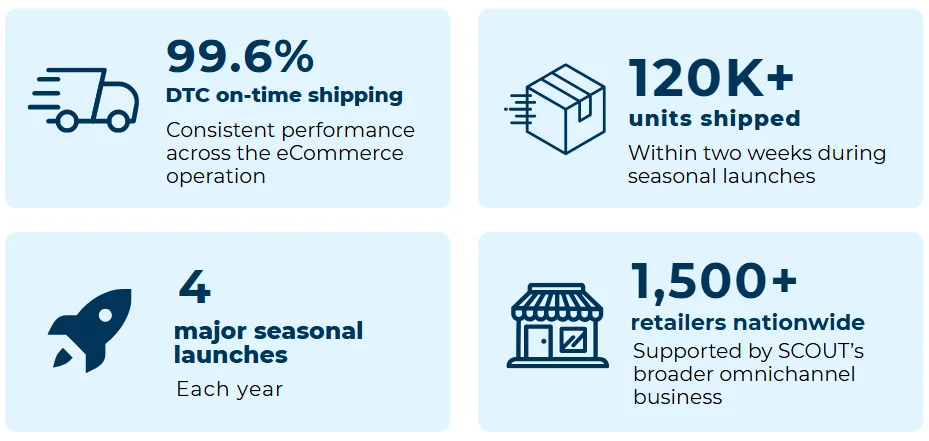
SCOUT ships 120,000-plus units in roughly two weeks for each of four yearly launches while maintaining 99.6% DTC on-time shipping.

SCOUT Bags’ fulfillment calendar has four major peaks a year, each requiring the warehouse to ship more than 120,000 units in about two weeks. Barrett Distribution Centers handles the physical fulfillment, and SCOUT reports maintaining 99.6% on-time shipping for direct-to-consumer orders through its launches.
That performance depends on accommodating sharp changes in volume while serving steady everyday demand and a mix of sales channels. SCOUT releases four seasonal collections annually, and each launch involves roughly 250 documented steps across the organization. The warehouse must prepare for the incoming collection while continuing to receive, store and pick products from the season already on sale.
SCOUT Bags has operated for 22 years, building a customer base around printed totes and other practical bags. The work behind each new collection is less visible: inventory and order flows have to adjust to a calendar that doesn’t follow the usual pattern of one major holiday peak.
Two demand patterns, one operation
More than half of SCOUT’s direct-to-consumer assortment consists of evergreen products, while its wholesale business follows the seasonal collection calendar. That means the operation has to manage repeat demand for core products alongside short, intense bursts tied to new releases.
SCOUT sells through its own direct-to-consumer channel, Amazon, more than 1,500 retailers, key accounts and corporate gifting. Each channel brings its own order requirements. At the same time, the next collection can arrive before the current one has finished selling, putting two seasons’ inventory into the receiving, storage and picking process at once.
Labor planning has to match SCOUT’s launch dates rather than rely on a single year-end ramp-up. The company also plans well beyond the next collection: it updates a five-year plan annually and maps its supply chain 18 to 24 months ahead. A fulfillment setup that can absorb launch surges and support channel growth is therefore part of the company’s longer-range operating needs.
Fulfillment equipment and workflows
Barrett’s operation uses several picking and packing methods to handle different order profiles. Flexible staffing and multiple pick fronts allow the team to increase labor and throughput for a collection launch, then shift back toward everyday order volume afterward.
- A Single-Line Single-Unit quick-ship process is used for orders containing one item.
- A Flex-Wall sorting system handles orders with multiple lines.
- Paccurate cartonization technology helps select cartons and supports pack-out.
- In-house embroidery, monogramming and patch sewing support personalized direct-to-consumer orders and SCOUT Select, the company’s corporate gifting and customization business.
These capabilities give the operation ways to process both standard orders and customized products within the same broader fulfillment setup. The different pick and sort processes also reflect the range of orders SCOUT serves, from a single item to orders with multiple products or personalization.
The facility’s location adds a regional advantage for the operation. It is near SCOUT’s Washington, D.C., headquarters and the Port of Baltimore, keeping the company and fulfillment team close while supporting inbound freight movement into Mid-Atlantic and Northeast markets.
More capacity for the business to grow
SCOUT says outsourcing physical fulfillment to Barrett has freed its internal team to spend less time troubleshooting orders and chargebacks and more time serving customers. The company says it has met and maintained its customer service standards while improving NetSuite processes and automating manual work.
Those operational changes have also supported expansion into business-to-business sales, drop shipping and broader EDI capabilities. For a company managing several channels with different order rules, that flexibility can make it easier to take on additional work without treating every new opportunity as a separate warehouse operation.
Kate Hanlan Kegan, SCOUT’s president, described the capacity to accept more business as a central outcome: “The biggest impact has really been supporting scale. In the past, we would have had to turn opportunities down. Having the ability to say yes to more has been really advantageous for us.”
Kegan discussed the company’s fulfillment needs with Katherine Wroth, partnerships and product marketing manager at Barrett Distribution Centers, Inc. The account centers on a practical requirement: the warehouse has to handle four concentrated launch periods while maintaining service for ongoing orders and supporting the company’s plans across multiple channels.
For SCOUT, the operating test comes around four times each year. Its reported on-time shipping rate, launch volumes, seasonal overlap and customization work show why capacity has to be planned around the brand’s actual calendar. The next measure of the arrangement will be whether the same setup continues to support new sales channels and future collection launches.


