Tuesday, October 20, 2026 · Trucking & Freight
SONAR Data Show Shippers Need Deeper Carrier Commitments Ahead of 2027 Bids
Noted by Julie Van de Kamp · 828 reads
With tender rejections up sharply and van contract rates 18.2% higher year over year, SONAR says shippers should seek capacity and network support in return.
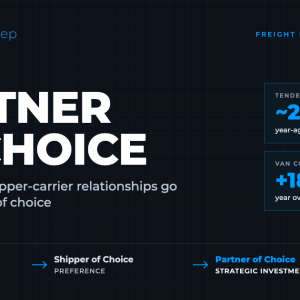
Higher contract rates are buying shippers a different kind of carrier conversation. SONAR data show tender rejections at 13.78% for the week of Oct. 6–12, 2026, compared with 5.48% in the same week a year earlier. Van contract rates were up 18.2% year over year as of Sept. 30. With carriers choosing where to place scarce capacity, the question for shippers is whether a higher price brings a dependable operating commitment or simply a higher cost per load.
That’s the distinction behind SONAR’s Partner of Choice report, which builds on its June 2026 Shipper of Choice report. A shipper of choice earns preference when a carrier decides which freight to accept. A partner of choice earns a deeper investment: drivers and equipment assigned to the relationship, surge capacity, network ideas and pricing flexibility. The report says carriers are making those longer-term choices ahead of the 2027 bid season.
Rates are rising faster than freight volume
The SONAR figures point to a market shaped more by tighter capacity than by a comparable jump in demand. Tender volume, measured by SONAR’s STVI.USA index, reached 11,202 for Oct. 6–12, 2026, up about 8% from 10,364 in the same week of 2025. Over that period, the tender rejection index, STRI.USA, climbed from 5.48% to 13.78%, an increase of about 150%.
For shippers, that gap matters. A larger share of tenders is going unaccepted even as volume grows at a more modest pace. SONAR’s van contract rate index, VCRPM1.USA, rose from $2.31 per mile to $2.73 per mile, or 18.2% year over year. The report’s rate readings are dated Sept. 30 in each year, the latest published values used in its comparison.
A higher contract rate can support a more reliable relationship, but the price alone doesn’t show whether a carrier is committing people and equipment to a customer’s network. Shippers have reason to ask what the rate is meant to secure: acceptance on individual loads, or capacity planning that gives the freight a more durable place in the carrier’s operation.
Capacity pressure differs by equipment and market
The national figures mask substantial differences among equipment types and freight origins. For Oct. 6–12, reefer tender rejections averaged 21.47%, while flatbed rejections averaged 19.01%. The van figure was 11.05% for that comparison. A shipper’s experience will therefore depend in part on the equipment its freight requires.
Origin markets also vary. Quincy, Illinois, had a tender rejection rate of 48.38%, and Cedar Rapids, Iowa, recorded 38.46%. By comparison, Lakeland, Florida, was at 3.25%, while Phoenix was at 3.55%. Those readings suggest very different capacity conditions across lanes: a shipment originating in one market may be much harder to cover than freight moving out of another.
SONAR points to network fit as a way to turn those differences into a practical exchange. A shipper with steady outbound freight from an inbound-heavy market can help a carrier place trucks where it needs loads. In return, the shipper may be able to seek priority on more difficult lanes. That exchange depends on the fit between the shipper’s freight and the carrier’s network; it isn’t a blanket promise that a carrier can cover every lane at the same level.
From load preference to network investment
The report describes three stages in shipper-carrier relationships. In a transactional arrangement, the conversation centers on the rate for a lane, and carriers may price for the possibility that freight will shift elsewhere. At the next stage, a shipper becomes a preferred customer because its facilities, tenders and payment practices make the freight easier to handle.
Those operating basics still matter. Short dwell protects driver hours, predictable tenders help carriers plan, and fair payment supports a workable business relationship. They make a shipper easier to serve, but they don’t by themselves mean a carrier will build its network around that customer.
At the partner stage, the relationship reaches carrier planning meetings, where teams decide how to allocate drivers, trailers and dedicated fleets. The carrier may bring forward network ideas and flag developing service issues early. The shift is from accepting or protecting individual loads to planning capacity and operations with the customer over time.
SONAR identifies five attributes for that stage: transparency, commitment, network fit, mutual problem solving and shared value. In practice, transparency gives both sides a clearer view of freight needs and operating constraints. Commitment means each side makes plans the other can rely on. Network fit connects those plans to the lanes and equipment that work for both businesses. The remaining attributes call for resolving operating problems together and sharing the value created by the relationship.
Commitments need to run both ways
A shipper’s contribution can include consistent freight, reliable forecasts and facilities that don’t leave drivers waiting. But the report makes clear that a carrier seeking a long-term commitment also has obligations: provide capacity, give early warnings when service is at risk, share market insight and offer fair pricing across changing conditions.
That reciprocity is a useful test for shippers weighing carrier proposals. A commitment should be specific enough to guide operating decisions on both sides. Shippers can ask how a carrier will support surge needs, what information it will share when a lane becomes difficult and how the parties will respond when actual volumes diverge from the plan. The source does not prescribe particular contract terms; those details depend on the freight and the relationship.
The report also looks at why partnership efforts in 2018 and 2020–2022 faded and what may differ in the current cycle. It includes a six-pillar bridge from SONAR’s earlier shipper-of-choice framework, lane examples using its Headhaul Index (HAUL), Lane Score and contract rates, and guidance on warning signs and corrective actions when relationships break down. A six-question self-assessment asks shippers to score their relationships with carriers on a scale of 1 to 5.
With contract repricing largely complete and carrier choices still taking shape, the practical window is before the 2027 bid season. Shippers can review where their freight helps a carrier’s network, identify the lanes where capacity is hardest to secure and make expectations for service and communication explicit. SONAR’s full report lists five actions for shippers to take before bids, alongside its assessment tools.
For access, visit SONAR’s sitrep page or use FreightWaves Market Monitor.