Monday, November 9, 2026 · Trucking & Freight
Motive Agents Automate Fleet Coordination for Field Service Teams
Noted by Kate Rechenmacher · 998 reads
Motive’s AI workflows can alert crews and managers, with driver identification and goal-based automation planned for 2027.
For landscaping and field service operators, daily changes to crews, trucks and job sites can leave dispatchers spending hours tracking updates. Motive’s Agents are designed to turn fleet data into alerts and actions, reducing the manual coordination required to keep jobs moving.
Teams that depend on phone calls and after-the-fact record checks can struggle to confirm where crews are, which vehicle a driver used or whether a job is complete. As work shifts from site to site, those gaps create recurring administrative tasks. Motive says field service teams that use its platform report recovering an average of 24 hours a week in productivity.
Motive estimates that preventable downtime, compliance violations and idling cost organizations $46 billion. In its 2026 ROI Report, 42% of surveyed organizations named operational inefficiency, including excess administrative work, as a top concern. Those figures frame the problem the company is targeting: staff often spend time collecting information that fleet systems already hold.
Motive Agents, powered by Motive AI, are workflows that monitor fleet data and respond when conditions set by an organization are met. Actions can include notifying dispatchers or managers, sending alerts by email, SMS or app, and delivering voice messages to drivers in the cab. The company says voice outreach through AI Dashcam Plus is planned for later this year.
Build workflows around operating conditions
Agents can be configured to watch for specific events and contact the people responsible for responding. A team might start with a prebuilt template for idling, vehicle fault codes or fatigue, then adjust the triggers and actions to fit its processes. Multiple triggers and responses can also be combined in one Agent, so a single workflow can cover tasks that otherwise require separate setups.
For teams with five trucks or five hundred, the practical aim is to reduce repeated check-in work as the number of vehicles and jobs grows. Dispatchers and field managers may spend substantial time updating estimated arrival times, returning customer calls and checking whether technicians completed a job. Automated alerts can give them a prompt to update customers or reassign resources when a crew is delayed or finishes early.
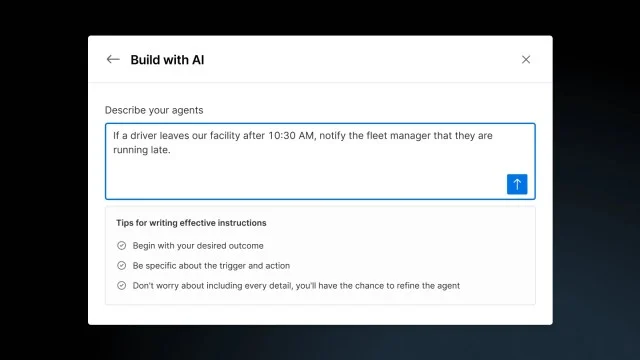
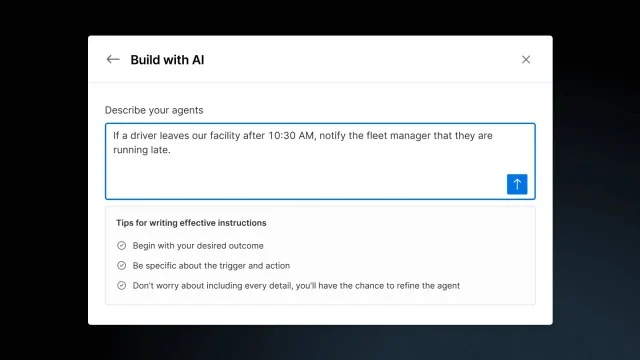
Motive also describes two ways to create workflows that are planned for early 2027. Users will be able to describe a process in plain language and have AI convert it into triggers and actions. They’ll also be able to set a target, such as more on-time jobs, and have Agents determine the steps. A library of Motive-built Agents, designed to run without configuration, is planned for the same period.
Prepare crews before they reach a job
Arriving without instructions about parking, equipment or site conditions can delay the start of work and leave crews less prepared. Dispatchers and managers may have to brief teams, check arrival times and pass updates between people working across multiple jobs. Agents can help by alerting managers when a job is complete or a crew is behind schedule.
The workflows can also brief drivers about weather and safety conditions along the route and at the job site. Motive says its Atlas assistant can provide gear requirements before drivers arrive, giving crews a chance to bring the equipment they need. In practice, timely preparation can help teams begin work sooner and give managers more time to handle exceptions that need their attention.
The value depends on whether the information reaches the right person in time to change what happens next. A completion notice can support a customer update or a resource shift; a delay alert can give a manager an opportunity to revise the day’s schedule. The source describes these as possible uses of Agents, not guaranteed outcomes for every operation.
Driver identification planned for 2027
Shared vehicles and frequently changing crews create another tracking problem: a trip may not be assigned to the driver who made it. That can leave managers sorting through records after the trip, while driving behavior, hours and labor costs may be attributed to the wrong person or job.
Starting in 2027, Motive plans to add Agent workflows that help identify drivers for trips. Atlas will be able to prompt a driver to sign in when a trip begins and send a reminder if the driver hasn’t done so. Motive says the feature is intended to reduce unassigned trips and help managers direct coaching to the driver responsible for the behavior being reviewed.
Identifying a driver at the start of a trip could reduce the later work of reconstructing who used which vehicle. For operators with shared trucks and changing crews, accurate trip records can also support clearer assignments of driving activity and labor to the right driver or job. The planned feature’s usefulness will depend on drivers responding to the sign-in prompts and managers acting on the resulting information.
Automation shifts the work toward exceptions
Motive’s current approach asks organizations to define the operating conditions and responses in advance. The company’s planned goal-based workflows would let a team describe an outcome and have the system build a path toward it. That changes how much setup the customer needs to do, while leaving the operational target with the team.
Agents are available today, and Motive says organizations can get started through its representatives or at its booth at NALP Elevate. For field service teams, the near-term question is which recurring updates can be automated without losing the context dispatchers need. The planned driver identification and goal-based features extend that question to shared vehicles and broader operating targets.
The post Motive Agents for field services teams: Tell Agents the goal. They handle the rest. appeared first on Motive.